

There’s no denying it.
Your kitchen is one of the busiest rooms in the home. It’s where everyone rushes for breakfast, where the kids do their homework, and maybe your occasional baking session.
And more often than not, you come into the kitchen with your hands full of groceries, plates that are destined for the dishwasher, and a pot of simmering soup. Or, hey, it could be the middle of the night, and you just want little snackies because you deserve it. Or a glass of water. That’s good too.
Either way, in moments like these, fumbling around for a light switch feels like an unnecessary extra task.
That’s where motion sensor lighting can make your everyday life easier. Instead of trying to elbow the switches or needing to put down whatever’s in your hand just to flip a switch, the lights are on the moment you step in.
That’s why in this guide, we’re going over some motion sensor kitchen lighting ideas that can help you make your LED kitchen lighting solutions work for you, rather than against you.
Why Motion Sensor Lighting Is Perfect for Kitchens
You could be a kitchen goblin and spend a lot of your time in the space. But unlike bedrooms and living rooms, kitchens are spaces where you're constantly moving from one task to another.
You might chop vegetables at the worktop, fetch ingredients from the cupboard, rinse dishes at the sink, then carry everything across to the dining table. Your lighting needs to keep up!
That’s where motion sensor lighting comes into play.
1. Biggest advantage? Hands-free lighting. I mean, that solves the majority of the annoyance you get from traditional switches. If you've ever tried to find a light switch while holding a roasting tray fresh from the oven, you'll appreciate lights that simply switch themselves on.
2. Better visibility is another major benefit. Think about it: an under cabinet light automatically switches on whenever you go over the worktop to chop vegetables, measure ingredients, or read recipes.
3. Motion sensors also help cut unnecessary energy use. It’s not uncommon for kitchen lights to stay on long after everyone's wandered into the lounge. Sensor-controlled lights all have an automatic switch-off function that prevents this from happening. Over time, this can help lower your electricity bill.
4. Then we have those quick trips downstairs for a glass of water and the occasional treat in the middle of the night. You don’t need every ceiling light blazing away like it's midday.
Gentle lighting beneath cabinets or along plinths provides just enough illumination to navigate safely without burning your eyesockets.
5. There's also the hygiene factor. Cooking often involves raw meat, flour, oils and sticky ingredients. Being able to activate lighting without touching a switch helps reduce the spread of germs and grime, and keeps surfaces cleaner.
6. And finally, if you’re already sporting a smart home system, motion sensor lighting can fit naturally into it. But even without a full smart home setup, sensors bring an automated feel that really changes the way you use your kitchen.
The secret, though, is knowing where in the kitchen different types of lighting work best.
Plan Your Kitchen by Lighting Zones
It’s easy to consider your kitchen as one large room. But did you know you could divide it into lighting zones?
Professional kitchen designers often layer lighting based on how each area is used. And you can definitely do the same with your motion sensor lights.
Instead of switching on every single light in the kitchen once movement is detected, it happens by zone.
Task Zones
This is where the main event happens in the kitchen. The zones would then be:
-
Worktops
-
Food preparation areas
-
Sinks
-
Hobs
You want bright, reliable lighting in these spaces because they're used for precision tasks. This is where under cabinet sensor lighting works particularly well. You can have LED strip lights or slim linear cabinet lights shine directly onto the work surface.
As you approach the workspace, the lights come on, making cooking feel effortless from the moment you begin.
Storage Zones
Shadows from overhead lights make the back of your storage (including cupboards, drawers, pantries, and corner cabinets) look like black holes where items you're looking for always seem to migrate to.
You don’t want to leave the lights inside your cupboard on all day, but having manual switches also makes the light an unappealing addition to your kitchen. The solution? Small motion sensor cabinet lights or door-triggered lights.
You open the cupboard doors, and the lights automatically switch on. Battery-powered and wired systems are available.
Walkway Zones
Some kitchen lights just need to make moving across the space easy and safe. You can add motion sensor lights in:
-
Kitchen entrances
-
Walkways between cabinets
-
Breakfast bar circulation
-
Open-plan transitions
This is the perfect lighting for those late-night munchies. You get enough visibility to avoid bumping into chairs or accidentally giving your kitchen island a free kick.
Low-level lighting just proves that bright ceiling lights aren’t always the solution.
Feature Zones
Not every light in your kitchen has to be practical. If you want to add personality to the space, feature lighting with a motion sensor can give you that.
Popular feature zones include:
-
Glass display cabinets
-
Decorative shelving
-
Kitchen islands
-
Plinth lighting
Someone enters the kitchen, and suddenly it comes alive with subtle architectural highlights or display places.
LED strip lights hidden beneath shelves, along cabinet edges, or under islands create a floating effect that gives kitchens a more premium appearance.
Use warm white light to help the kitchen feel welcoming during evenings.

The Best Motion Sensor Lighting Ideas for Every Kitchen Area
Now that you have your zones figured out, choosing the right solution for each zone should be a breeze.
Rather than installing the same fitting everywhere, mixing different lighting styles creates a kitchen that's not just practical, but also comfortable and visually balanced.
Under Cabinet Motion Sensor Lights
This is one of the timeless kitchen lighting solutions no one should sleep on.
Wall cabinets often block ceiling light, creating shadows on one of the spaces that matter most in the kitchen: your worktops. Installing under cabinet sensor lighting solves this problem by directing illumination on the worktop.
LED strip lights are a popular choice because they provide continuous, even light while keeping a low profile. But another great choice is linear cabinet lights if you’re looking for a more rigid fitting.
Pairing these with motion sensors ensures the lighting activates whenever someone approaches the preparation area, making cooking feel more intuitive while avoiding wasted electricity.
Inside Kitchen Cupboards
How many times have you lost your spice jar to the unforgiving void that is the back of your kitchen cupboard?
Install compact motion sensor cabinet lights that automatically switch on when movement is detected or when cupboard doors are opened. This should illuminate all the nooks and crannies of your cupboard.
Battery-operated lights are quick to install and ideal for existing kitchens. Batteries will need charging or replacing.
For new kitchen builds, wired cabinet lighting is a better choice for a more permanent installation.
Pantry Lighting
You might have a well-organised pantry, but if you can barely see anything every time you walk in or pull the larder, then you have a problem.
Sensor-controlled lighting makes ingredients easy to find. As you enter or open the pantry, the lights activate automatically, illuminating shelves from top to bottom.
This removes dark corners, improves visibility and helps keep everything organised.
If you’re looking for even illumination, slim LED strip lights fitted vertically along shelving often provide sufficient lighting.
Kitchen Island Lighting
Kitchen islands are the command centres of modern kitchens. They become breakfast bars, homework stations, entertaining spaces and food preparation areas all in the same day.
Pendant lights remain the classic choice above islands, but motion sensors can work alongside them rather than replacing them.
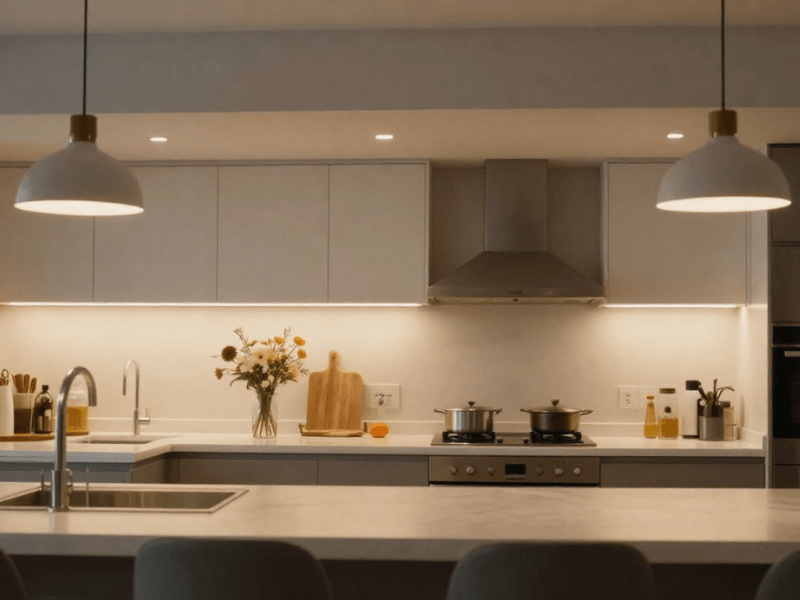
What you can do then is have sensors activate the pendant lights as someone approaches, while hidden LED strip lights beneath the island create a subtle floating effect. This enhances the room’s overall ambience.
This layered approach combines decorative lighting with practical functionality.
Plinth Lighting
If you want to make navigation easier after dark, especially on late-night kitchen visits, install these lights beneath base cabinets to cast a gentle glow across the floor.
This way, there’s no need to switch on bright ceiling lights for a quick grab-and-go trip, since the low-level plinth lighting provides just enough illumination to move around safely.
These lights also add a contemporary design element that helps define the space in the evening.
Combined with motion sensors, plinth lighting becomes almost effortless, quietly guiding you through the kitchen whenever needed.
Utility Areas
Many homes now combine kitchens with utility rooms or laundry spaces, making consistent lighting even more important.
If your kitchen area houses:
-
Laundry cupboards
-
Utility rooms
-
Cleaning supply storage
-
Recycling areas
Motion sensor lighting ensures these spaces are illuminated only while in use.
For example, cabinet lights inside cleaning cupboards make it much easier to locate supplies, while ceiling-mounted sensor lights automatically activate when carrying washing baskets between rooms.
These are small improvements to your kitchen, but the effect on your daily life can be very significant.
Recommended Lighting for Every Kitchen Zone

Choosing the Right Sensor for Kitchen Lighting
One of the factors you’ll need to consider when choosing your sensor light is the technology behind it.
The good news? You don't need to become a lighting engineer to understand the basics.
PIR Sensors
PIR (Passive Infrared) sensors are the most popular option for kitchens. If you review the table above, you’ll notice this.
These sensors don’t detect movement in the literal sense. Instead, they detect changes in infrared energy, a.k.a. body heat. As you walk into its detection zone, the sensor recognises the sudden changes in heat and switches the light on.
They’re a popular choice for residential installations since they’re reliable, energy-efficient, and ideal for everyday kitchen use.
PIR kitchen lights work especially well for:
-
Under cabinet lighting
-
Walkways
-
Pantry lighting
-
Utility rooms
-
Plinth lighting
Microwave Sensors
These use a different technology altogether. They emit low-power microwave signals and monitor how those signals bounce back. It’s kind of like sonar, but with microwaves instead of sound waves.
These are more sensitive than PIR sensors, so they need slightly more careful positioning.
Use this if you have large family kitchens, kitchen diner layouts, and open-plan living spaces.
Door Sensors vs Motion Sensors
Door sensors are the better choice for cupboards, wardrobes and enclosed storage. A door sensor simply activates the light when the door opens and switches it off again when it's closed.
Motion sensors, on the other hand, activate whenever movement is detected nearby.
Choose door sensors when:
-
Lighting cupboards
-
Illuminating drawers
-
Installing lights inside pull-out larders
-
Lighting enclosed cabinets
Choose motion sensors when:
-
Lighting worktops
-
Illuminating walkways
-
Creating plinth lighting
-
Lighting utility rooms
-
Activating feature lighting
But why limit your kitchen to only one and not the other? Many kitchens actually benefit from using both technologies together.
Motion sensors can handle the main circulation areas, while door sensors provide instant lighting inside storage spaces.

Which LED Lighting Works Best with Motion Sensors?
Now that you’ve got the sensor figured out, it’s time to choose the lights. Different zones will need different types of lights.
LED Strip Lights
This is probably the most versatile choice for all kinds of lighting. Their slim profile makes them easy to hide beneath cabinets, inside shelving, behind light rail mouldings, or along plinths.
Using LED strips creates clean lines of light without the usual bulk from rigid lighting alternatives.
When paired with motion sensors, these lights can even add a “shock factor” to unknowing guests, remaining almost invisible until someone approaches and they light up.
Linear Cabinet Lights
Your kitchen aesthetics might be calling for a more structured appearance. Then linear cabinet lights are a fantastic option.
These rigid fittings provide continuous illumination in neat, evenly distributed lines. They’re perfect for long worktops, food preparation areas, or breakfast bars.
These are great for task lighting since they produce consistent, shadow-free lighting.
LED Downlights
Most kitchens use this as the foundation of their overall lighting scheme. They deliver broad ambient illumination across the room while allowing task and accent lighting to do the finer work.
Pro Tip: Don’t rely on ceiling lights alone. Combine downlights with under cabinet lighting to create layered illumination that feels brighter without increasing energy consumption.
Puck Lights
Puck lights are ideal wherever focused lighting is needed.
Install them inside cupboards, display cabinets, glass shelving, and small storage areas.
Trust me, these lights make finding items much easier, especially since the back of cupboards and cabinets don’t get much illumination from ceiling lights.
Motion or door sensors work equally well depending on where the lights are installed.
Flexible LED Sheets
Flexible LED sheets are becoming increasingly popular for kitchen lighting.
If you haven’t heard of them yet, they’re like LED strip lights, but they come as a panel. Imagine lining up several LED strip lights side by side and stitching them together.
The result is smooth, uniform illumination without the bright spots sometimes associated with individual LED strips.
How Motion Sensor Kitchen Lighting Saves Energy
Has this ever happened to you?
You pop into the kitchen to make a quick sandwich, your phone in hand, playing a YouTube video you can’t peel your eyes off. You leave the kitchen without bothering with the switch on the way out.
Before you know it, the lights have been on for the last 3 hours with no one using the kitchen.
The same problem happens with traditional lights in your cabinets and cupboards. If you’re not mindful, you can leave those lights on for a long time, sometimes even overnight.
These are probably good signs that you need motion sensor lights for your kitchen, don’t you think?
These lights don’t just automatically switch on your lights; they also have an automatic shut-off function that switches off your lights when no movement is detected for a set period.
LED Technology
You might be scratching your head thinking,
“But I’m already using energy-efficient LED lights. Surely the consumption is not that big even when the lights are left on for hours.”
The added cost might be small when you look at it per individual instance. If you look at it over time, though, the costs add up.
With motion sensors, you can lower the operating time of your lights. And since LED lights already last thousands of hours, limiting the time that they’re on extends their lifespan.
We’re talking less wear, which means you'll spend less time replacing your kitchen lights over the years.
Motion sensor lights may be a simple upgrade, but the significance of their impact can’t be denied.
Kitchen Design Ideas Using Sensor Lighting
Modern Minimalist Kitchens
Hidden lighting works particularly well here.
You can conceal LED strip lights beneath cabinets to create task lighting for your worktops without any visible hardware. Sleek aesthetic is the name of the game here.
Make sure the sensors are discreet too.
Cool white temperatures (4000K up) are a good choice for complementing most modern designs.
Traditional Kitchens
You want a softer approach here, so use warm white lighting (around 3000K). This enhances any wooden material and classic design details. This also creates a cosy and inviting atmosphere.
You don’t want technology to interrupt the traditional appearance, so make sure the sensors are also positioned discreetly.
Open-Plan Kitchens
Light is usually used to define areas in open-plan kitchens. The solution? Layer your lighting.
Combine:
-
Ambient ceiling lighting
-
Under cabinet task lighting
-
Island feature lighting
-
Sensor-controlled walkway lighting
-
Plinth lighting
The result feels more balanced, while motion sensors ensure that specific areas are illuminated when in use.
Compact Kitchens
Just because a kitchen is small doesn’t mean it can’t benefit from thoughtful lighting.
Quite the contrary! Strategically positioned sensor lighting helps remove dark corners and creates the illusion of a larger room.
At the same time, because sensor lighting only activates when needed, compact kitchens also avoid feeling overly bright.

Upgrade Your Kitchen with Smart Sensor Lighting from Simple Lighting
Good kitchen lighting isn’t about adding more lights. What you want to do instead is have the right light in the right place working at the right time.
This way, you can create a kitchen that's easier to cook in, simpler to navigate and more enjoyable to spend time in every day.
Simple Lighting has a wide range of high-quality LED kitchen lighting solutions and motion sensor options designed to help you create a kitchen that works for how you use the space.
If you’re ready to create a smarter, more efficient kitchen, check out our website today!


0 comments