


When was the last time you thought to yourself while you were away from home, “I can’t wait to get home and spend time in the hallway”? I’ll bet you never once did.
Hallways are neither here nor there in our homes. They’re relatively busy areas, yes. But they’re transition spaces, which means the longest time you spend there on a daily basis is usually just mere seconds.
That’s why when it comes to lighting, they’re often an afterthought.
Traditional hallway lighting can be surprisingly inconvenient. When walking into the space at night, you typically have to step into the dark first before you can reach (or fumble) for a wall switch.
In some cases, you even accidentally leave the lights on far longer than necessary.
This is where smart sensor lighting for hallways can make a difference. The lights automatically come on when you enter and switch off when the space is empty. Simple. And that’s what we’re all for here.
In this guide, we’ll help you better understand sensor lights and which hallway motion sensor lights are best for your home.
Why Hallways Are Perfect for Sensor Lighting
Think about how you actually use your hallway. You walk in. You walk through. You leave.
Most of us don’t treat our hallways as we would our living room or kitchen, where we usually spend hours at a time… because frankly, it’s a different space.
But that doesn’t mean lighting here should be old and neglected. Quite the opposite, in fact.
That’s why hallway sensor lighting is particularly useful here because the lights don't need to stay on continuously. A sensor detects movement, automatically turns the light on, and switches it off again once you've gone.
Perfect for a space that only sees short bursts of activity.
For busy households where people are constantly moving between rooms, this is especially helpful. You don’t need to look for the switch every time you pass through, and there’s no worry of the lights being left on overnight.
You’ll also thank having sensor lights in your hallway every time you get home carrying shopping bags, holding a sleeping child, or bringing in a large parcel. There’s no need to put everything down or try to elbow the switches to turn the lights on.
Automatic lighting improves visibility, especially after dark, making sure that the hallway is illuminated even before you step into the space. (Would depend on how you install the sensors.)
This is not to say that traditional switches are bad. It’s just that for spaces like hallways, they can be inconvenient at times.
How Smart Hallway Sensor Lighting Works
Okay, the word “smart” might throw you off in this context. We’re not talking about complicated technology or an army of apps.
At its core, motion sensor lighting simply means a sensor detects someone entering the hallway and tells the connected light to switch on. After a set period without further movement, it switches the light off again.
Motion Detection
Many hallway lights use passive infrared sensors, better known as PIR sensors. And these sensors don’t detect movement per se.
Rather than detecting movement as a camera would, PIR sensors monitor changes in infrared energy, or heat, within their detection area. Because people and animals give off body heat, the sensor can recognise changes when somebody moves through the space.
Once movement is detected, the light activates automatically.
Every sensor has a detection zone, which means the area it can monitor. Any changes in this zone will trigger the lights to turn on.
This is why positioning is critical, especially for hallways. Ideally, the sensor should detect somebody as they enter rather than only after they've walked halfway down the corridor.
Automatic Switch-Off
The beauty of motion sensor lighting is that once the sensor stops detecting activity, a timer begins. Once this timer reaches zero, the light automatically switches off.
Many modern sensor lights let you adjust this delay, so you can tailor the light to your space. A short hallway may only require a brief illumination period, while a larger entrance hall or hallway connected to a staircase might benefit from a longer setting.
This automatic switch-off function means you don’t have to think about the light at all.
You can step into your hallway at night with shopping bags in one hand and groceries in the other. The lights automatically switch on, and you walk through. Once you've disappeared into the kitchen, the light switches itself off.
"Did I turn that light off?" would never be a question you’ll ever ask again.
The Benefits of Smart Sensor Lighting for Hallways
Convenience might be the first benefit you notice, but smart sensor lighting for hallways can improve everything from safety to energy consumption.
Hands-Free Convenience
Walking to the light switch and pressing it is hardly strenuous. Yet there are plenty of situations where hands-free lighting becomes genuinely useful and ideal.
The coming home example is one, but frankly, anytime you come home with your hands occupied, automatic lighting becomes very useful. It’s also equally practical for visitors unfamiliar with where your switches are, and anyone moving boxes or household items.
Even pets moving through a detection zone may activate some sensors, depending on their sensitivity and positioning. Whether that's useful or something you'd rather minimise will depend on you, so it’s better to get one with adjustable features.
Improved Safety
Automatic illumination can help reduce the risk of trips and falls by making obstacles, steps, and changes in floor level easier to see.
This can be particularly valuable for elderly family members and anyone navigating the home during the night.
If your hallway connects directly to a staircase, combining hallway sensors with LED stair lighting makes the transition between the two areas much smoother. Your lighting can help guide movement through the space.
Lower Energy Bills
A hallway light left running for an extra ten minutes doesn't sound dramatic. Do it several times every day, across multiple fittings, and those wasted hours begin to stack up.
With sensor-controlled lighting, your fittings only operate when needed. Once the hallway is empty, the timer switches them off. These sensors are usually paired with energy-efficient LED lights, so the savings over time can be massive.
Simply put, removing unnecessary operating time is an easy way to cut waste.
Longer LED Lifespan
LED lights are rated for a lifespan of 20,000 to 50,000 hours of continuous operation. By removing unnecessary operating hours, you can “extend” that lifespan.
If a hallway light doesn't need to run for several hours every evening, there's little reason for it to do so.
Fewer operating hours can mean less frequent replacement and lower maintenance for your lights. This is especially handy when they’re positioned in high or awkward locations.
Modern Home Appeal
Nothing says “My home is modern” more than lighting that automatically switches on when you step into the hallway. You walk out, and the light takes care of itself. So futuristic!
Even a simple hallway can have that unmistakable contemporary feel when the lights are responsive. Better still, sensor lighting can work alongside other smart home lighting features if you want greater control.
Who knew a thoughtfully positioned sensor and well-chosen LEDs could make a surprisingly big difference?

Choosing the Best Sensor Light for Your Hallway
If anyone tells you they have the “one” fitting that’s right for every hallway, you might want to step back a bit and reconsider. Because in reality, there’s no one-size-fits-all solution to lighting.
Size, ceiling height, layout, and interior style all matter.
The best results for any kind of lighting often come from layering: combining general ambient illumination with task and accent lighting, rather than asking one lonely ceiling LED light bulb to do everything.
Ceiling Lights
Sensor ceiling lights are a good first choice for most hallways because they provide broad, even illumination from above.
Flush or low-profile fittings are great for spaces with limited ceiling heights. They keep the space looking clean as they don’t intrude into valuable space.
For longer or larger hallways, you may need several fittings positioned along the route rather than one extremely bright light in the middle. This way you don’t get harsh shadows, especially when you have your back to the light source.
Wall Lights
Wall lights introduce another layer of illumination. They're particularly useful in narrow corridors where decorative lighting can make the space feel warmer.
Circling back to layering lights, these can work as secondary illumination alongside ceiling fittings. Still, that depends on the hallway layout and the light output, as these can be a more prominent part of the overall lighting as well.
Stair Lights
If your hallway leads directly to stairs, pairing your hallway lights with sensor-controlled stair lighting is well worth considering.
Rather than treating the hallway and stairs as separate spaces, they create one continuous, well-lit pathway through your home. The stair lights can act as a second layer of illumination while the hallway lights provide general ambient lighting.
This is both decorative and practical, especially at night when you may not want a powerful ceiling light blazing away at full brightness.
LED Strip Lighting
If you’re looking for creative freedom in your lighting, LED strips are the best choice.
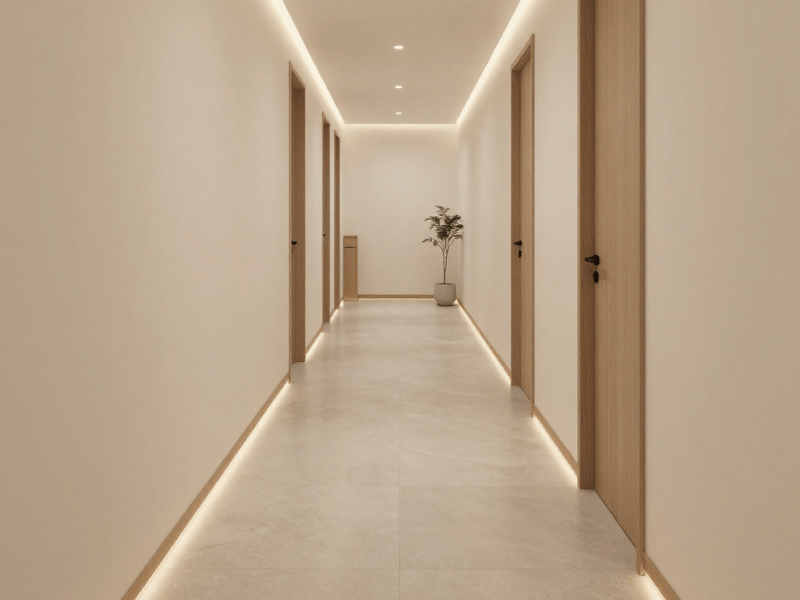
Try installing them beneath handrails, along skirting boards, or recessed into walls. The light source can remain relatively hidden while producing a soft line of illumination through the hallway.
It's particularly effective in modern interiors and can provide useful low-level accent lighting at night.
Whatever lighting you choose, remember the golden trio: efficient LED fittings, intelligent sensor controls, and layered illumination.
PIR Sensors vs Microwave Sensors for Hallways
Motion sensors come in different technologies. This means they don’t work the same way but can give the same results. Two options you'll commonly encounter are PIR and microwave sensors.
PIR Sensors
These are the most popular choice for residential hallways. That’s because they’re reliable, energy-efficient, and generally cost-effective. This makes them an ideal choice for basic residential setups.
For a typical corridor, entrance hall or landing, PIR will often provide everything you need.
Microwave Sensors
Microwave sensors work differently. Unlike PIR sensors that continuously “monitor” heat changes, they emit microwave signals and detect changes in the reflected signal caused by movement.
You might think, “Oh no, microwave! Dangerous!”
No. These microwave signals are very weak. In fact, they’re thousands of times weaker than a smartphone or Wi-Fi router. So, you and your cat or dog should be quite alright.
They’re usually more sensitive than PIR sensors and may detect movement through certain thin materials, depending on the installation and product.
This extra sensitivity can be useful in larger or more complicated spaces, which makes these ideal for commercial spaces or warehouses.
Here's a quick comparison:

Pro Tip:
For most homes, PIR provides a wonderfully simple solution. Microwave technology becomes more attractive where the shape or size of the space makes conventional detection trickier.

Hallway Design Ideas Using Smart Sensor Lighting
After all this, you might be thinking that sensor lighting is purely practical. That’s not true! Get the right fittings and placement, and they can be decorative too!
Modern Minimalist Hallways
Keep things clean.
Install recessed downlights, slim ceiling fittings, and concealed LED strips to create a minimalist interior. This way, you get plenty of illumination without visually cluttering the ceiling or walls.
Traditional Homes
Traditional doesn’t mean outdated. Sensor technology can happily hide behind a more traditional appearance.
Decorative wall lights combined with warm white LEDs can create a cosy, welcoming entrance. The sensors can be discreetly positioned to provide the automatic functionality.
You get the character of traditional lighting without giving up modern convenience.
Open-Plan Hallways
These spaces require a little more thought because the hallway may flow directly into another room. Zoning becomes useful here.
Rather than activating every light in sight whenever someone enters, divide the area into logical lighting zones.
Ceiling lights can provide ambient illumination while wall lights or LED strips handle accent lighting. Again, it’s all about layering.
Narrow Corridors
You need careful light placement here. Try to distribute fittings evenly instead of concentrating all the brightness in one spot.
Consider beam angles too! A very narrow beam can create bright pools surrounded by dark areas. Wider beam angles can produce a more comfortable result.
Wall-mounted or concealed LED lighting can also help reduce harsh shadows.
Common Hallway Sensor Lighting Mistakes
1. Placing the sensor too close to the door or in a position where its detection zone doesn't cover the approach properly. Always check the detection pattern and position the sensor so movement naturally crosses it.
2. Getting a light with an incorrect detection angle. This can cause similar problems as the one above. If your lights only activate after you've already walked several steps into the darkness, you could use a little adjusting of the sensor.
3. Setting the timer too long. This defeats the energy-saving benefits. If it takes you 20 seconds to cross the hallway but the lights remain on for 15 minutes afterwards, well… that’s a massive room for improvement, don’t you think? Start with a shorter setting and adjust it based on how you actually use the space.
4. Wrong lux levels. Some sensors are designed not to activate when there's already enough ambient daylight. If your light isn't turning on, check whether the lux threshold is preventing activation.
5. Furniture, large decorations, and plants can interfere with detection. Keep the sensor's intended field of view clear as much as possible.
6. Choosing excessive brightness. This one is easy to get wrong. Hallways don't necessarily need glaring lights, especially late at night. Excessive brightness can make the transition from a dark bedroom rather unpleasant.
7. Installing too few fittings. Don't compensate for poor placement by simply installing fewer, brighter fittings. A long corridor may benefit more from several appropriately spaced lights.
Smart Features That Improve Hallway Lighting Even Further
Adjustable Lux Settings
Lux settings determine the ambient light level at which the sensor becomes active.
For example, you might want your hallway motion sensor lights to respond after sunset but still remain off during a bright afternoon when daylight still provides enough visibility.
Adjustable Timer Functions
Timer controls let you decide how long the lights remain on after movement is no longer detected. This can vary based on several factors that will be different from home to home.
There's no magic number. The best setting is the one that matches how your household uses the space.
Smart Home Integration
If you’ve already got a smart home lighting system, some sensor lighting can easily integrate into it. This can give you additional options such as app control, schedules, or voice commands.
Always check product compatibility before getting them to avoid issues later on.
Dimmable Sensor Lighting
Sensor lighting is great, until it’s the middle of the night and you’re on your way to get a glass of water only to be greeted by a blinding flash of light from the hallway.
Some sensor lights have dimming functions. Softer lighting can create a more relaxed atmosphere while still providing enough visibility to move around safely.

Upgrade Your Hallway with Smart Sensor Lighting from Simple Lighting
Your hallway might primarily exist to connect other rooms together, but that doesn’t mean its lighting should be an afterthought.
The first upgrade that you can do to improve your hallway lights is adding a sensor light or two (depending on how long your hallway is).
Pair that with energy-efficient LED lighting and follow proper light layering, and you can turn even an ordinary corridor into a far more welcoming part of the home.
At Simple Lighting, you can explore a wide range of sensor ceiling lights, other PIR hallway lighting solutions, stair lighting, and LED strip lighting for hallways.
Whether you’re looking for lighting that complements modern or traditional interiors, Simple Lighting is sure to have options suited to your needs.
Check the website now and enjoy expert advice when you’re unsure of what to get, fast UK delivery, and generous manufacturer warranties.
Take the first step today in creating a safer, smarter and more energy-efficient hallway with the right sensor lighting from Simple Lighting.


0 comments