
Getting up should be the hardest part of the morning, not getting dressed. But when your wardrobe is too dark and your shelves are hidden in shadows, even choosing an outfit can become such a challenge.
That is why dressing rooms need proper attention during planning, too. The solution is not “We’ll get some bright, fancy lights for it later”. You need different layers working together for visibility and practical use of the space.
Good dressing room lighting should help you see clothing clearly, compare colours accurately, and find accessories without rummaging through every drawer. Below are ideas that will help you create a space that's practical, comfortable, and a pleasure to use.
How to Plan Dressing Room Lighting Around Your Daily Routine
First, think about how you use your dressing room. How you use yours can differ from how your neighbours use theirs. What do you actually do inside? This will shape your lighting.
Start With the Main Dressing Room Zones
Divide your depression room into different main areas.
- Wardrobe: Hanging rails, drawers, and deep corners need clear lighting so you can distinguish colours and fabrics.
- Full-length mirror: Use balanced lighting so you can see your outfit without harsh shadows or distracting reflections.
- Dressing table: Use focused, flattering light to make everyday grooming easier.
- Display shelves: When displayed under focused lighting, shoes, handbags, and accessories pop out and give the room a high-quality feel.
Each zone has a distinct purpose. Give them the light they need instead of filling the ceiling with downlights.
Layer Ambient, Task, and Accent Lighting
These are the three types of lighting you need to combine.
- Ambient lighting provides general illumination throughout the room. Ceiling lights and downlights are common choices.
- Task lighting is for activities such as checking an outfit, choosing jewellery, or applying makeup. Mirror lights and integrated wardrobe lighting can perform this role.
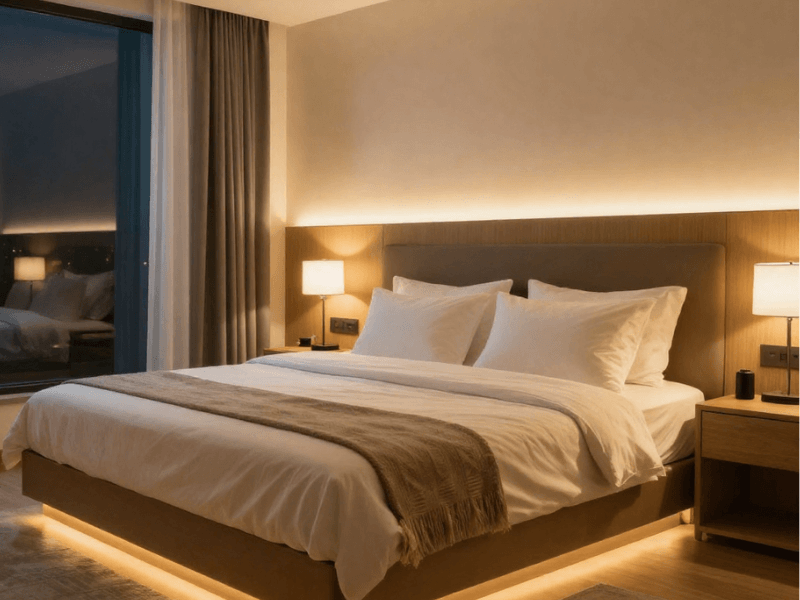
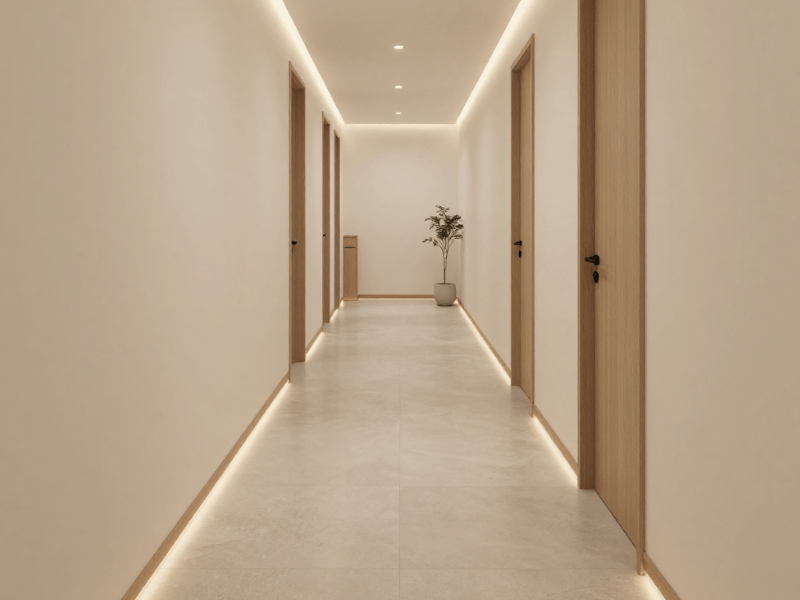
- Accent lighting highlights selected features, including open shelving, decorative displays, and architectural elements. LED strip lights are particularly useful here because they can fit into narrow spaces without taking up valuable space. Perfect for small dressing rooms.
Each type of light should not be expected to cover for the other. This means that you should have each type in your room in locations where they make sense.
Dressing Room Lighting Ideas for Wardrobes
You might think lighting a wardrobe is straightforward. Pick a bright fitting and stick it up top, right? But clothes can block the light, deep cupboards can develop dark corners, and different finishes create different effects (dark surfaces absorb light, while pale ones reflect it).
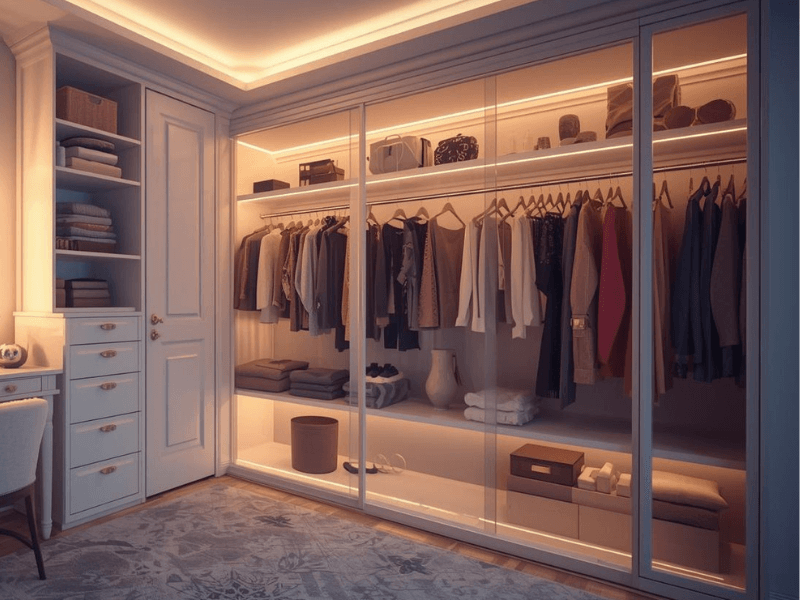
Add LED Strip Lights to Hanging Sections
You can brighten hanging rails using LED strips, making it easier to distinguish similar colours. We've all had that moment under the wrong light when we thought we picked the black shirt, only to find out it’s navy blue in brighter light!
A common installation method is positioning the strips along the front edge of each shelf or along the vertical edges for more even coverage. For a neat, professional finish, consider an LED aluminium profile with a frosted diffuser.
Illuminate Drawers and Deep Wardrobe Corners
Belts, watches, jewellery, and folded tops. They’re usually the hardest things to find, especially when they disappear into deep drawers.
Compact cabinet lights or LED strips can help illuminate these spaces without taking up much room. Position them so the contents are visible when the drawer opens, while keeping the light source protected from knocks and everyday handling.
For maximum convenience, choose door-activated or motion sensor lights. Imagine walking toward the wardrobe and the lights turning on automatically, or pulling a drawer and instantly getting light, so you can see the contents easily. Pretty chic.
Choose Lighting for Open and Fitted Wardrobes
Concealed lighting is your best friend here. For fitted wardrobes, strips can sit inside side panels, beneath shelves, or near hanging rails. Open wardrobes, on the other hand, offer fewer concealed lighting options, so choose discreet fittings like LED strips and use aluminium profiles for visible installations.
Plan cable routes beforehand to keep the setup clean and clutter-free. Also, avoid mounting the lights where they shine directly into your eyes or reflect off glossy surfaces.

Mirror Lighting Ideas for Seeing Your Outfit Clearly
Your mirror is arguably the most important part of your dressing-room lighting plan. If your face looks shadowy or your outfit appears a different colour in the reflection, your lighting is definitely wrong.
Position Lights to Reduce Shadows
A single ceiling light can cast shadows beneath your eyes, chin, and nose. Shadows your body casts onto your outfit can also make it harder to judge whether the jeans and shoes work together.
If you have a full-length mirror, position light vertically beside it or around its edges. An exposed LED strip alone is a bad choice because of glare, so use a diffuser-equipped profile to spread the light evenly. The same principle applies to dressing table mirrors.
Choose Between Frontlit and Backlit Mirrors
Frontlit mirrors direct light towards the person standing in front of them. They’re a more practical choice for dressing, grooming, or applying makeup.
Backlit mirrors glow from behind, often creating a soft halo on the wall. Their primary function is decorative lighting, which pairs well with other accent lights. These can’t provide enough light on your face or body for detailed tasks. Keep this difference in mind when choosing an LED mirror.
Use Colour-Accurate Lighting for Outfit Checks
When considering colour accuracy, look for colour rendering index (CRI) ratings. This measures how accurately artificial light reveals colours compared to natural daylight. A higher number is always preferred (ideally a CRI of 90). The highest rating is 100.
Choosing anything below 80 can wash out or distort colours, making it hard to coordinate an outfit before heading outside.
Shelf Lighting Ideas for Shoes, Bags, and Accessories
Open wardrobe shelves are a lighting design opportunity.
Fit Under-Shelf Lighting for Better Visibility
Mount an LED strip under a shelf to illuminate the items below. This can help you see shoe colours, folded garments, and smaller accessories more easily. Keep the placement consistent so the lighting looks balanced. Otherwise, the whole wardrobe will look patchy if you install lights differently.
Some shelves are deep, so make sure the light reaches the back. You may need to adjust the mounting position or choose a different fitting to achieve more even coverage.
Use Concealed Lighting to Highlight Display Shelves
Your handbags, statement accessories, and collectables deserve extra attention. What better way to do that than by highlighting them with lights?
Position a strip beneath the front edge of a shelf, inside a recess, or along a side panel to create a gentle wash of light. Exposed LED nodes can cause uncomfortable glare, so use profiles and diffusers to conceal them and soften the effect.
Avoid Glare and Uneven Brightness
We’ve already been mentioning glare earlier and the simplest way to avoid it. Other factors to consider include shelf depth, reflective finishes, and strip placement. Glossy finishes are especially problematic if you don't account for them, since they can reflect bright points.
Dark, matte shelves, in contrast, can make the same fitting feel less effective. So, keep this in mind before choosing your lights. The best way to know for sure is to test the lights from the angles you'll normally view the shelves. Make adjustments when necessary.
How to Match Colour Temperature and Brightness Across the Room
A dressing room should feel like one space, not several unrelated lighting schemes competing for attention.
Choose a Consistent Colour Temperature
The mood your wardrobe gives off depends on the colour temperature of the lights you choose.
Warm white lighting (2700K-3000K) creates a relaxed, inviting atmosphere. It has a yellowish tint and works well if your dressing room doubles as a quiet retreat. Pair it with neutral finishes and softer accent lighting to really boost the atmosphere.
Natural white (4000K) is often a practical choice for selecting clothes because it looks more natural. It also works well for grooming. Use it around mirrors and in wardrobe interiors.
Choose based on what your wardrobe needs and the atmosphere you prefer.
Balance Brightness Rather Than Adding More Lights
Better lighting doesn’t mean more fittings. Overlighting creates harsh hotspots or uncomfortable glare. Before buying a boatload of fittings, consider the room’s dimensions, ceiling height, available natural light, surface finishes, and how much light clothing or shelving blocks.
Also consider dimming. This can help you adjust the atmosphere throughout the day. Just make sure the dimmer or controller you’re getting is compatible with the whole lighting setup, not just the lights.
Check Colour Rendering Before Buying
As I mentioned earlier, a CRI of 90 or more is ideal for outfit-checking areas. A rating of 80 might still push it, but anything lower will start affecting how everything in the space looks, colour-wise. Check the manufacturer's specifications before buying.

Photo by Billy Jo Catbagan on Unsplash
Dressing Room Lighting Solutions for Different Layouts
Good wardrobe lighting means adapting the same principles we’ve discussed above to different layouts.
Small Dressing Areas and Bedroom Wardrobes
In a compact dressing area, large, bulky fittings aren’t ideal. Well-placed recessed downlights provide general illumination, while LED strips brighten the wardrobe interior.
Add lights beside a full-length mirror to create a functional dressing zone. To avoid visual clutter and make the small space feel tidier, conceal the lights where possible. Since most dressing areas are in the bedroom or next to it, align your wardrobe lights with the bedroom LED strip lighting to create a smooth transition between spaces.
Walk-In Wardrobes With Dedicated Dressing Areas
If you’ve got a walk-in wardrobe, then you’ve got more flexibility to create separate lighting zones. Add lights around hanging rails, inside drawers, and beneath shelves. And don’t forget about the full-length mirror. Give it its own task light as well. For general illumination, some well-placed ceiling lights will do nicely.
Use separate switches for each zone so you can light only the areas you need. For instance, you can turn on the wardrobe lights while choosing clothes without lighting the display shelves. A single central switch for all the lights is wasteful.
Luxury Dressing Rooms With Display Shelving
Luxury doesn’t mean excessive brightness or an overly dim atmosphere.
Combining practical lights with decorative details is typically the best approach for balanced, well-thought-out lighting. The secret is to give each light a job:
- Concealed shelf strips can highlight handbags and accessories
- Integrated wardrobe lights can keep clothing visible
- Decorative fittings can add character
Establish the functional lighting first, especially around mirrors and wardrobes. Once those are set up, use accent lighting to create depth.
Lighting Controls That Make Getting Ready Easier
To make getting dressed easier, start by removing unnecessary complexity from your lighting.
Use Sensors Inside Wardrobes and Drawers
Lights that respond to movement and occupancy can switch on automatically when you access your wardrobe. This is especially handy in frequently used drawers, since you don’t need to switch the lights on manually. Check that the sensor, light, and power supply are compatible.
Control Mirror and Accent Lighting Separately
Zoning, or using separate switches for your lights, lets you use only what you need: bright task lighting when getting dressed and softer accent lighting for a more relaxed atmosphere. Plan the controls before installation to avoid awkward switch positions and unnecessary wiring changes later.
Common Dressing Room Lighting Mistakes to Avoid
Watch out for these common problems and mistakes.
Relying on One Central Ceiling Light
The solution isn’t to get one strong light source. This can leave clothes, drawer interiors, and mirror areas in shadow. Instead, divide the total light output needed across different lighting types for a layered approach. Combine general, task, and accent lighting so that each layer fills gaps that the others cannot easily reach.
Choosing Decorative Lighting Over Visibility
Sure, a backlit mirror or a softly lit shelf can look beautiful, but can it provide enough light to check an outfit or see small accessories clearly? Prioritise ambient and task lighting first, especially where you need accurate visibility. Add decorative lighting as a finishing touch that improves the atmosphere.
Forgetting Profiles, Drivers, and Cable Routes
Installing LED strips may be straightforward, but they need more planning than simply sticking them onto a surface.
Consider where the strips will sit, how cables will reach the power supply, whether you need aluminium profiles, and how you'll maintain the installation. For any installations that need a direct-to-mains connection, hire a qualified electrician.

Create a Coordinated Dressing Room Lighting Plan
Plan Each Lighting Zone Before Buying
Before ordering anything, work through this checklist:
- Measure the room: Note the ceiling height, wardrobe dimensions, shelf depth, and mirror position.
- Identify dark spots: Check deep cupboards, drawer interiors, and corners that receive little light.
- Choose your lighting layers: Decide where you need general, task, and accent lighting.
- Prep the installation: Mark mounting positions, cable routes, driver locations, and switch positions.
- Compare specifications: Check lumens, colour temperature, CRI, voltage, and compatibility with any dimmers or sensors.
- Test before committing: Check brightness, colour consistency, and glare from normal viewing angles before permanently installing the fittings.
Choose Lighting That Works Together
A well-lit dressing room uses different layers of light, combining them to create a space that’s both functional and stylish.
Each layer has its purpose, but the overall result should feel cohesive. You want to see your clothes clearly, enjoy the atmosphere, and move through your morning routine without fighting the lighting. If you’re ready to upgrade your dressing room, explore Simple Lighting’s dressing room lighting range for fittings to suit different layouts and styles.


0 comments