


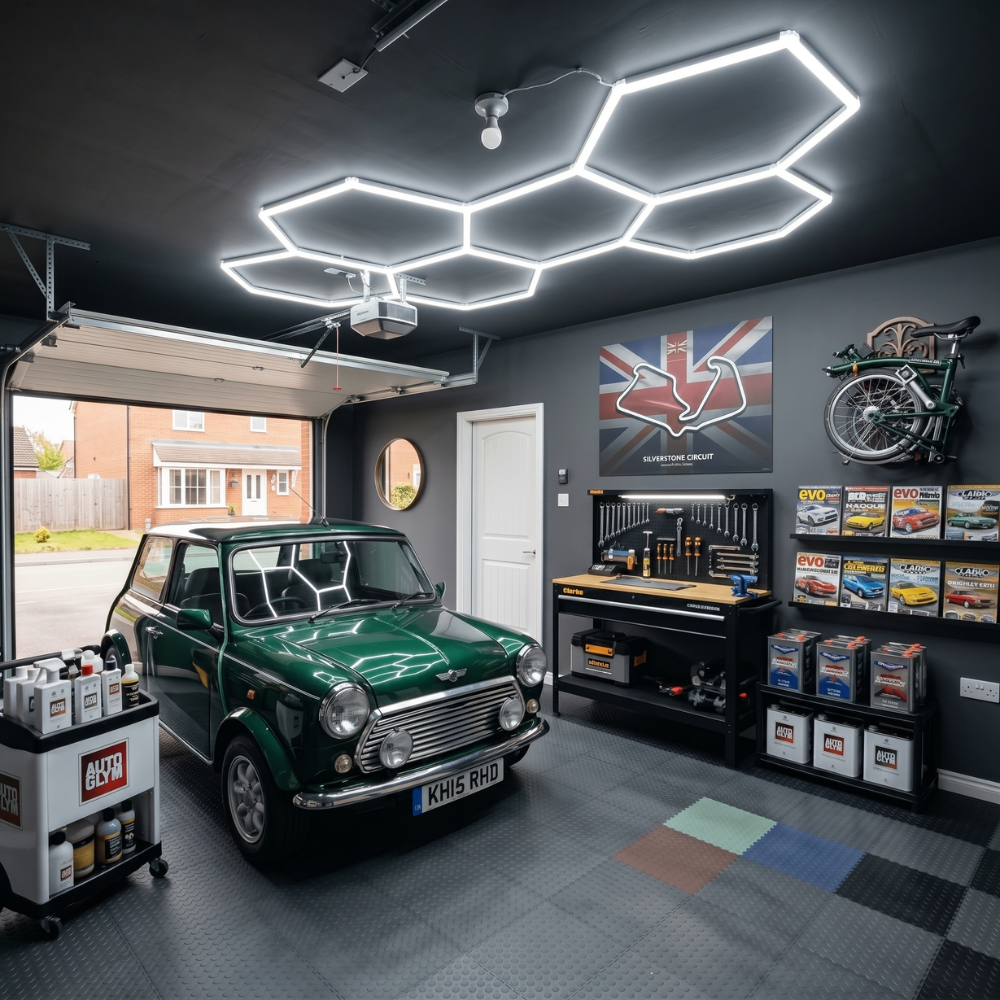

LED battens or hexagon lights? One keeps things simple, while the other can turn your garage into a detailing studio. Both can brighten your workshop, but they solve slightly different problems. Your choice affects coverage, shadows, installation costs, and how comfortably you handle everyday jobs.
LED battens generally suit repairs, storage, and DIY, where reliable illumination matters most. Hexagon systems appeal to detailers who also want an impressive ceiling design. But a garage rarely serves just one purpose. Sometimes, the most practical answer is to combine both rather than choose a winner.
This LED batten lights vs hexagon lights guide compares their strengths, limitations, and running costs. Learn what suits your space without buying a ceiling full of unnecessary extras.
What Is the Difference Between LED Battens and Hexagon Lights?
Both use LED technology, but their shapes influence how you plan your lighting. One uses separate linear fittings; the other connects multiple sections into geometric patterns.
How LED Batten Lights Work
LED battens are long, narrow fittings installed individually or in rows. They suit rectangular garages, storage areas, workbenches, and general workshop ceiling layouts. You can space them around a parked vehicle or position them above frequently used areas. Different lengths, wattages, and colour temperatures offer flexibility when matching your room.
Simple Lighting's LED batten lights include options for different ceiling sizes and conditions. For product-specific advice, read about choosing LED batten lights for garages.
How Hexagon LED Lights Work
Hexagon lights connect individual LED tubes into honeycomb-style layouts. Their many light sections spread illumination across several positions on the ceiling. The striking pattern also turns overhead lighting into a design feature. That's appealing when your garage doubles as a detailing bay, filming space or vehicle showcase.
Simple Lighting offers hexagon LED light kits in different sizes, including cool white and RGB options. See these hexagon LED garage lighting ideas for layout inspiration.
Why They're Compared
The real difference is whether straightforward coverage or a distinctive, connected design matters more. Actual performance depends on the complete installation, not the shape alone.
LED Batten Lights vs Hexagon Lights for Brightness and Coverage
A fitting's brightness tells only part of the story. What matters is how much usable light reaches your tools, vehicle, and working surfaces.
Which Gives Better General Illumination?
Battens are easy to position in parallel rows across a rectangular ceiling. This makes them particularly useful for garages with several separate working areas. Hexagon systems spread light across a connected grid, often covering a substantial ceiling section. Their layout can help illuminate a vehicle from several overhead positions.
Don't compare one batten against an entire hexagon kit. Compare the total lumens and wattage of two complete layouts designed for the same space. Also check beam angles, mounting height, and fitting spacing. A poorly positioned high-output system can still leave frustrating dark spots.
Which Is Better for Reducing Shadows?
Working beneath an open bonnet can block light from a single overhead fitting. Shelving, machinery, even your own shoulders can create similar problems. Hexagon layouts offer several light positions, which can soften shadows around curved surfaces. However, multiple battens positioned on either side of a vehicle can also work well.
What About Garage Size and Ceiling Height?
Small single-car garages often suit a few carefully spaced battens. Large hexagon layouts may take up more ceiling space than the room comfortably allows. Double garages offer room for multiple batten rows or a dedicated hexagon section. Higher ceilings may require greater output or closer attention to positioning.
Before ordering, measure usable ceiling space and check the complete kit dimensions. Include garage-door tracks, beams, and storage systems in your plan.
|
Feature |
LED Battens |
Hexagon Lights |
|
Coverage |
Linear fittings arranged across work zones |
Connected sections spread across a ceiling grid |
|
Shadow control |
Good with careful spacing |
Multiple light positions can help |
|
Layout |
Independent straight fittings |
Fixed geometric patterns |
|
Expansion |
Add compatible individual fittings |
Extend compatible modular systems |
|
Appearance |
Discreet and functional |
Bold and decorative |
|
Typical use |
Repairs, DIY and general lighting |
Detailing and vehicle presentation |
The best setup isn't necessarily the brightest on paper. It's the one that illuminates the places where you actually work.

Which Lighting Is Better for Repairs and Workshop Tasks?
Think about your most common jobs before choosing workshop lights. A mechanic, detailer, and hobby woodworker won't necessarily need the same arrangement.
LED Battens for Everyday Repairs
Changing brake pads, checking fluids, or repairing bicycles? LED battens are usually the practical choice for these everyday jobs. Their linear design makes it easy to illuminate working areas without building a complex ceiling pattern. Position fittings on either side of your vehicle to reduce shadows during maintenance.
Hexagon Lights for Vehicle Detailing
Detailing demands good visibility across curved panels and glossy finishes. A distributed hexagon layout creates reflections that can help you notice uneven surfaces. However, the pattern alone doesn't guarantee accurate paint inspection. Check colour rendering, brightness, and positioning before buying garage detailing lights.
Dedicated inspection lights still help spot fine defects and check colour-sensitive work. Even the fanciest ceiling can't replace the right inspection equipment. Simple Lighting's cool white hexagon kits offer 6500K, alongside a CRI above 80. For demanding paint assessment, consider additional lighting with specifications suited to that task.
Workbenches and Precision Tasks
Building furniture or repairing electronics brings light closer to your hands. Overhead fittings can leave shadows beneath shelves, tools, and larger components. Either ceiling system can provide general illumination around the bench. For fine work, add an adjustable lamp or suitable under-shelf lighting near the surface.
This gives you better control over where light reaches. You can explore more professional workshop lighting ideas for demanding tasks.
Comparing Appearance and Workshop Style
Good lighting should suit the space, not fight it. The visual difference between these two systems is immediately noticeable.
The Understated Look of Battens
Battens keep your ceiling tidy with simple, straight lines. They're ideal when you want tools, storage, and work areas to take priority. Their understated appearance suits practical workshops and industrial interiors. Nobody needs to admire the ceiling before changing a tyre.
The Statement Made by Hexagon Lights
Hexagon lights make the ceiling part of the attraction. Their geometric pattern suits detailing studios, vehicle photography, and filming workshops. Their popularity also reflects the growing interest in stylish garage conversions. Discover more about the popularity of hexagon garage lighting.
Match the Design to Your Space
Consider ceiling colour, wall finishes, and available mounting space. A compact garage might suit a smaller hexagon feature rather than a full ceiling grid. Choose a design that complements the room without crowding it. Remember that darker finishes may require more careful lighting placement.
Cost and Energy Efficiency: Which Is Better Value?
Compare purchase price, electrical work, running costs, and future replacement needs. The cheapest individual fitting doesn't always mean the cheapest finished installation.
Initial Purchase Cost
Individual battens are often a budget-friendly starting point for garage upgrades. Prices vary with length, wattage, output, protection rating, and additional features. Hexagon kits combine multiple tubes and connectors, so the full layout influences the price. Bigger patterns can mean more components and a higher initial spend.
Compare complete installations that cover similar areas rather than individual fitting prices. Include any wiring, mounting accessories, and professional installation costs.
Which Uses Less Electricity?
Neither design automatically uses less power. The total wattage of everything switched on determines electricity consumption. For example, four 40W battens draw 160W together. A complete hexagon system drawing 160W uses the same electricity over identical operating hours.
Their light output may still differ considerably. Compare lumens per watt to understand efficiency, then assess whether the light reaches your working areas. You can estimate running costs using this formula. Simply enter your installation's wattage, operating hours, and electricity tariff.
Total watts ÷ 1,000 × hours used × electricity price per kWh = running cost
A 160W setup used five hours daily consumes 0.8kWh. At an illustrative 25p per kWh, that costs 20p per day. Use your actual tariff for a more accurate estimate. Separate switching can reduce consumption when only one area needs illumination.
Maintenance and Long-Term Value
Consider product warranties, expected lifespan, and replacement options before buying. Check whether failed fittings or individual kit sections can be replaced separately. Battens may be easier to replace individually, subject to electrical compatibility. Hexagon extensions and replacement tubes must work with the existing system and power arrangement.
Installation and Layout: What Changes?
Both systems need proper planning before installation. However, their layouts offer different levels of flexibility.
Planning a Batten Layout
You can mount battens individually, making them adaptable around beams and garage-door tracks. Straight rows alongside vehicles or benches often provide practical coverage. Consider any equipment that could block overhead illumination. Plan electrical connections and switching before deciding where every fitting goes.
Planning a Hexagon Layout
Connected hexagon tubes need more careful measuring because the pattern occupies a defined area. Check the full assembled width and length, not merely individual tube dimensions. Simple Lighting's cool white kits use modular connections and offer ceiling or wall mounting. Suspension options may also be available, depending on the product.
Follow the manufacturer's instructions and electrical requirements. Have a qualified electrician complete hardwired connections.
Expansion and Environmental Protection
Adding another batten may be straightforward when your electrical installation supports it. Expanding hexagon lighting depends on compatible sections, connectors, and available power capacity. Environment matters, too, especially in garages exposed to moisture or heavy dust. The referenced cool white hexagon kits are IP20-rated and intended for suitable dry indoor conditions.
Some battens offer higher IP ratings, including IP65 options. Check the chosen model rather than assuming every batten provides the same protection. For more options, explore Simple Lighting's workshop lighting range. Compare fittings against your garage conditions before purchasing.

Can You Combine LED Battens and Hexagon Lights?
You don't need one system to handle every job. For a mixed-use garage, different lighting zones can be more useful than an all-or-nothing choice.
Start With General Lighting
Imagine a double garage used for weekend repairs, car detailing, and DIY. Install battens across the general work area, storage spaces, and walkways. Position them to reach the sides of your parked vehicle and nearby cabinets. This creates dependable background illumination even when the detailing bay isn't in use.
Add a Hexagon Detailing Zone
Place a suitably sized hexagon arrangement above the main vehicle detailing area. Its distributed layout can provide useful reflections while giving that zone a distinctive finish. There's no need to cover every corner with matching patterns. Concentrating the feature above one bay often makes better use of your budget.
Give the Workbench Its Own Light
Under-shelf LED strip lights for workbenches can illuminate small parts and tools. Choose products with suitable output, protection, and installation requirements. Portable dedicated LED work lights also help with awkward repairs. They let you aim light beneath a vehicle or inside machinery when overhead fittings fall short.
Use Separate Switches
Keep general lighting, the detailing feature and task lights on separate controls where practical. Then you can illuminate only the spaces you're using. This helps reduce unnecessary electricity consumption during smaller jobs. For more layout guidance, see planning a practical DIY workshop.
Which Should You Choose for Your Garage Workshop?
Start with your most frequent activities, then consider your budget and ceiling. The following recommendations provide a useful starting point.
Choose Battens for Practical Everyday Lighting
If your garage mainly handles repairs, DIY, and storage, battens are usually the sensible option. They're straightforward to arrange and available in specifications for different workshop conditions. Prioritise total output, fitting positions, and appropriate environmental protection. A simple layout planned properly can outperform a more elaborate one.
Choose Hexagons for Detailing and Presentation
If you regularly polish vehicles or film garage projects, hexagon lights may justify their additional cost. They combine distributed overhead illumination with a distinctive ceiling feature. Check the full kit dimensions, colour rendering, and wattage before ordering. Add specialist inspection lighting when your work requires more precise visibility.
Choose Both for Several Work Zones
A multifunctional garage can benefit from battens over general areas and hexagons above the detailing bay. Add dedicated task lighting wherever close-up jobs demand it.
|
Main Priority |
Recommended Option |
Why |
|
General garage use |
LED battens |
Practical, flexible coverage |
|
Repairs and DIY |
LED battens |
Easy positioning around work zones |
|
Vehicle detailing |
Hexagons with inspection lighting |
Distributed light and useful reflections |
|
Garage photography |
Hexagons |
Distinctive appearance |
|
Multiple work zones |
Both |
Tailored lighting for each area |
|
Bench precision work |
Either, plus task lighting |
Focused illumination close to the job |
|
Damp or dusty conditions |
Suitably IP-rated fittings |
Appropriate environmental protection |
Don't choose purely from photographs of impressive garages. Consider choosing the right garage lighting before committing to a layout.

Find Your Garage Workshop Lighting at Simple Lighting
LED battens suit practical general lighting, while hexagon systems bring distributed illumination and visual impact. Combining them can give a multifunctional workshop the flexibility it needs.
Explore Simple Lighting's LED batten lights and hexagon LED light kits to compare current options. Check dimensions, lumens, wattage, colour temperature, protection ratings, and installation requirements before buying. The right setup helps you work comfortably. An impressive ceiling is a bonus, not the entire job.


0 comments