





YES, you can put LED strip lights in a bathroom… but not every strip can be installed there.
That means you shouldn't install ordinary IP20 LED strips beside a shower or bath, even if they're hidden behind a cabinet. IP20 strips are designed for dry indoor environments, not places where they may face splashes, water jets, or persistent moisture.
But it’s not just the strip that needs to be water-resistant or waterproof (depending on the zone).
The whole setup: strip, power supply, and controllers (if any) needs to be suitable for the location.
So, when asking whether LED strip lights can be used in a bathroom, the better question isn't simply, “Is this LED strip waterproof?”
Ask: “Is the entire installation suitable for this particular bathroom location?”
That means there is a lot to consider beyond just the light’s IP rating. And that’s what we’re going to uncover in this guide.
Ready to get wet? Let’s dive right in.
Where Can You Put LED Strip Lights in a Bathroom?
It depends heavily on where the strip is going. Here are some of the most useful applications.
Around a Bathroom Mirror
This is probably one of the easiest ways to give your bathroom a more polished look.
You can easily buy LED bathroom mirrors, but if it’s not in the budget or you want to keep your current mirror, an LED strip light is a good option.
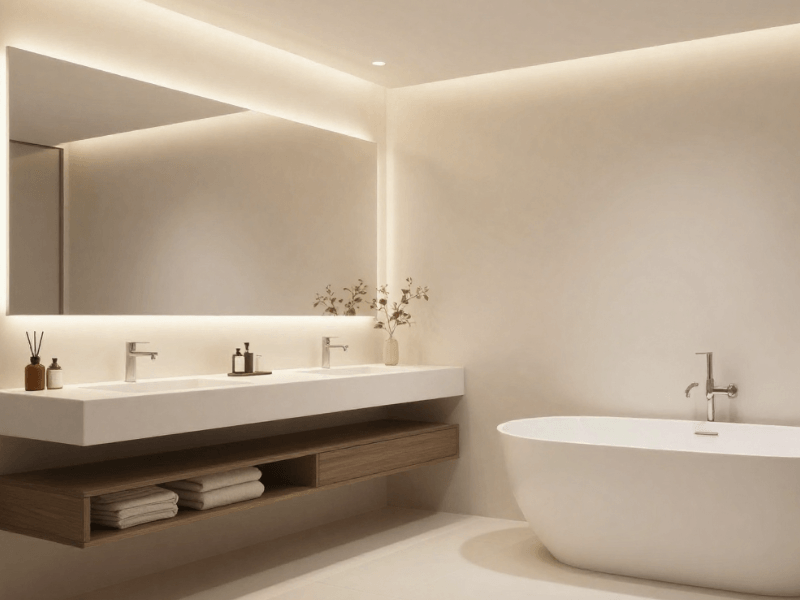
You can hide a strip behind the mirror to create a soft halo of light around its edges. It can also highlight the shape of an unusually sized or frameless mirror.
Bathroom layouts differ, so positioning still matters. A mirror mounted close to a shower or bath may fall within a bathroom zone that needs a higher IP rating, while one that’s located further away may need a lower IP rating.
Under Bathroom Cabinets and Vanity Units
You won’t know the beauty and usefulness of low-level lighting until you have it. And LED strips are a great way to add that to your bathroom.
Tuck one underneath a vanity, and it can provide useful lighting. The strip stays hidden, but the light makes the furniture look like it's hovering slightly above the floor.
It’s a neat trick if you're after a more modern-looking bathroom.
Of course, since it’s in the bathroom, assess its actual exposure to splashes and its bathroom zone before buying the strip.
Around Bathroom Niches and Shelves
If you have a recessed niche, then it’s practically begging for LED strip lighting.
You can conceal the strip around the edge or inside the niche. This can help draw attention to tiles, bottles, stonework, and other finishes.
But here’s the thing: many niches are inside the shower area. Even if it’s in a recessed space where it might be shielded from direct shower splashes, as long as it’s in the shower zone, it still needs a high water-protection rating to be safe.
A recessed space can still be exposed to spray, cleaning water, steam and condensation.
Along the Floor, Plinth or Bath
Another low-level LED lighting to add a soft glow along a plinth or around the base of bathroom furniture. You can also use it around the outside of a bath as decorative lighting, as long as the strip and installation are appropriate for its position.
Of course, we also have to consider proximity to water. Water splashes and condensation are pretty common in bathrooms, after all.
What IP Rating Do LED Strip Lights Need in a Bathroom?
Despite the need for protection, you don’t need strips with the highest IP rating unless necessary. It’s recommended to use strips (and other LEDs) with the correct rating for the bathroom zones they’re installed in.
What Does the IP Rating Mean?
Ingress protection (IP) rating tells you how well electrical equipment is protected against solid and water ingress.
It’s shown as two numbers (e.g. IP20, IP44, or IP65), with the first number indicating protection against solid objects and dust. The second number relates to protection against water.
For bathroom lighting, that second digit matters most.
The lowest IP rating you’ll typically see for lights is IP20. For bathroom lighting, common ratings are IP44, IP65 and IP67, with IP68 as the highest rating. We’ll discuss the difference below.
Note that these ratings describe specific levels of protection, not a simple “waterproof or not waterproof” label.
IP20 LED Strip: Where It Can Be Used
These are your “standard” LED strips, intended for dry indoor environments. This means that you should not treat them as bathroom-safe simply because they're not directly beside the shower.
Even when installed on the other side of the bathroom, IP20 LED strips are still not suitable in this location. Bathrooms can be humid and steamy, and condensation can reach poorly protected components.
Use IP20 strips only in other dry rooms in the house.
IP44 LED Strip: Splash-Resistant Applications
This is ideal for use in bathroom areas where the water ingress risk is relatively limited… but not zero.
This IP rating is ideal for installations in areas exposed to occasional splashes. When discussing zones, this is usually recommended for Zone 2.
IP65, IP67, and Higher: When More Protection Is Needed
An IP65 light is protected against water jets, making it more suitable for locations with more significant water exposure.
IP67 goes further by providing protection against temporary immersion.
“But wouldn’t it be smarter to just get IP67 lights?” I’m sure you’ll ask.
The answer is no.
If your strip is safely outside the zones and only needs protection against occasional splashes, buying a heavily protected product could simply add cost and make the installation more complicated than necessary.
Higher IP-rated lights tend to be bulkier, and that added protection can create installation challenges.
If you’re installing in a zone that only needs an IP65 rating, only use IP65 strips.

Bathroom Zones: Why Your LED Strip's Location Matters
But where exactly are these bathroom lighting zones?
UK bathroom installations are divided into Zones 0, 1, and 2, based on proximity to the bath or shower.
Zone 0: Inside the Bath or Shower
This is inside a bath or shower tray where water can collect.
If you were planning on adding floor lighting here, get strips that are made for Zone 0. They should be at least IP67. Anything lower should be banned. This is the highest-risk area of the bathroom for installing lights.
It's still best to consult a professional, registered electrician for safety and peace of mind.
Zone 1: Above the Bath or Shower
This covers the area above the bath or shower and can experience considerable spray, steam, and condensation. The typical recommended IP rating here is IP65.
However, the National Inspection Council for Electrical Installation Contracting (NICEIC) notes that equipment in Zone 1 must suit the location according to the manufacturer's instructions, and additional protection may be required where water jets are likely.
That is, a simplistic rule like “IP65 equals Zone 1” is not a standard. They still advise checking the actual product specification, voltage, manufacturer instructions, and installation conditions.
Take the IP rating-to-zone as more of a guide than a definite rule.
Zone 2 and Outside the Zones
Past Zone 1, the risk of direct water exposure is generally lower, but it doesn't mean you should ignore humidity, condensation, or product suitability.
An IP44 LED strip should give you confidence and peace of mind about lighting safety in this zone. Again, still check the specs and manufacturer guidelines.
Don't Forget the LED Strip's Power Supply
The LED strip is not the only thing you need to worry about.
Where Should the LED Driver or Power Supply Go?
Or rather, the question should be: Should the LED driver be positioned where the strips are installed?
For bathroom installations, NICEIC states that the SELV (Safety Extra-Low Voltage) source must be located outside the wet zones (Zones 0, 1, and 2). They should also be accessible, even when hidden, for easy maintenance and replacement.
The Driver Must Match the LED Strip
Not all LED drivers can power LED strips. They must match the strip's electrical requirements:
-
Voltage
-
Total wattage
-
Driver capacity (with an added 10-20% safety margin)
-
Driver type
-
Suitable connections
-
Dimming compatibility, if required
Here’s a golden rule to help you choose the right LED driver: a 12V strip needs a compatible 12V driver, and a 24V strip needs a compatible 24V driver. Never mix and match.
You’ll be surprised at how many people think a 24V driver should work with a 12V LED just because it has a higher voltage.
What About Connectors and Cable Connections?
Your LED strip’s IP rating does not magically make every connector, joiner, or cable entry connected to it waterproof. If your installation needs multiple sections of strip, make sure the connectors you use are also appropriately protected.
The idea is really not complicated. Connectors and joins with an IP rating that doesn't meet the required standard become safety risks.
If an IP65 rating is required, the whole setup needs to be IP65.
Which Bathroom LED Strip Light Should You Choose?
By this point, choosing your LED strip should be easy.
Choose the IP Rating for the Installation Location
Again, don’t default to: “I need the highest IP rating available.”
Start with: “Where is this strip going, and what level of protection will it need?”
That should effectively narrow down your search. Remember, you don’t need to pay for unnecessary added protection where you don’t need it.
Check the Voltage
Low-voltage LED strips often operate at 12V or 24V, but “low voltage” doesn’t automatically mean “safe to install anywhere in a bathroom”.
Make sure the strip and the driver have matching voltage.
Consider the Colour Temperature
The colour temperature of your lights sets the bathroom's mood.
-
Warm white creates a softer, more relaxing atmosphere, which works nicely around baths and low-level accent lighting.
-
Natural white offers a balanced appearance (not too warm or too cool) that works well for everyday bathroom use.
-
Cool white creates a crisp, clean look that’s ideal for task-focused areas such as mirrors.
Consider the lights you already have in the bathroom before choosing your strip’s colour temperature. If the rest of the bathroom uses cool white light (5000K), then adding a contrasting warm white light (2700K) might make the space feel unbalanced.
Think About Brightness
I’m not here to tell you to replace your main bathroom lighting with strip lights. In fact, it should not.
Instead, use the strip for layered bathroom lighting:
-
Accent lighting
-
Under-cabinet lighting
-
Backlighting
-
Feature lighting
-
Low-level lighting
Your ceiling lights can handle general illumination while LED strips add softer pools of light exactly where you want them.

The Best Ways to Use LED Strip Lights in a Bathroom
Now we’re at the fun part.
Create a Backlit Bathroom Mirror
Does your bathroom mirror look a bit boring? Hide a strip behind it to create a soft halo of light. This instantly transforms even the simplest mirror into a feature.
It also adds depth to the space, particularly when the rest of the bathroom uses darker tiles or finishes.
Of course, some LED bathroom mirrors come with built-in lighting, but where’s the fun if you can’t DIY it, right?
Add Under-Vanity Lighting
Add a strip beneath a vanity to create a subtle glow at floor level.
This makes the furniture look like it’s hovering, and it’s especially useful at night. Late-night bathroom visits can be jarring, especially when you need to switch on the ceiling lights just to see where you’re going.
With this low-level lighting, you don’t have to burn your eyeballs every time you use the bathroom half asleep.
Highlight a Shower or Bath Niche
Plain recessed niches can also become a bathroom feature with a simple strip addition.
Use it to highlight textured tiles, stone finishes, or carefully arranged bathroom products. The effect can be subtle, especially when the strip is hidden behind a lip or when you use a diffuser.
Add Low-Level Night Lighting
You’re not limited to the vanity if you prefer low-level lighting.
A dim or low-output LED strip along a plinth, a cabinet, or another suitable low-level position can provide gentle illumination for nighttime trips to the bathroom.
You get enough light to see where you're going, and your eyes aren’t fried.
Common Mistakes When Installing LED Strip Lights in a Bathroom
Using an IP20 Strip Near Water
An IP20 strip belongs in dry conditions. Installing one near a bath, shower, or anywhere water could get into the components is a grave mistake. A dangerous one. Follow the manufacturer's guidelines for where you can use the strip.
Assuming Silicone-Coated Means Suitable Everywhere
A strip covered in silicone might look waterproof, but if the specification says otherwise, don’t even try installing it in risky zones. Make sure that rating is appropriate for the location where you're installing it.
Forgetting About the Driver
Your strip might have the correct IP rating, but its driver might be sitting somewhere it shouldn't. Remember, the driver is part of the installation too.
Leaving Connections Exposed
This is similar to putting on a Mac with holes in the side where water can still seep in. Check the joints, connectors, cable entries, end caps, and seals, particularly where the installation could encounter water.
Choosing the Wrong Strip for the Job
Just because a strip looks bright or comes in the colour you want doesn’t make it the right one for the job. Consider:
-
IP rating
-
Voltage
-
Power consumption
-
Length
-
Colour temperature
-
Installation position
Installing Bathroom Electrics as a DIY Project
Bathroom electrical work carries additional safety requirements. So, we strongly recommend putting the screwdriver down if you’re not a certified electrician.
If you're planning a new bathroom lighting installation that involves electrical work, such as connecting directly to the mains, have a professional assess the location and carry out the installation.

Can You Put LED Strip Lights in a Bathroom? The Simple Answer
Yes.
Though it’s more of a “Yes, but…”
Yes, but only if the LED strip, power supply, connections, and installation are all suitable for the bathroom location.
Here’s a checklist you can use:
-
Where will the strip be installed?
-
Which bathroom zone is that?
-
How much water or spray could reach it?
-
What IP rating is appropriate for that location?
-
Does the strip have that IP rating?
-
Where will the LED driver be installed?
-
Does the driver match the strip's voltage and power requirements?
-
Are all connectors, cable entries, and joints appropriately protected?
-
Does the manufacturer confirm the product is suitable for the proposed installation?
-
Is the electrical work being carried out safely and in accordance with current requirements?
Once you answer those questions, LED strip lighting can be a brilliant addition to a bathroom.
Ready to start planning? Explore Simple Lighting's range of LED strip lights today to get your project going.


0 comments