

Have you ever walked into your bathroom and thought: “I need a better bathroom light”? More than likely, the first thing you thought about was brightness.
Understandable. Most people think that too. Brightness is highly associated with being a “better” light. But is it really?
I’m here to tell you: NO. More lumens doesn't necessarily mean a better-lit bathroom. (or any room)
In fact, an overly bright lighting fixture, especially when installed the wrong way, can leave you squinting in front of the mirror, making the whole bathroom experience a bad one.
The trick is finding the right balance between brightness, positioning, and how you actually use the room. It’s also understanding that natural light, ceiling height, wall colours, fitting positions, and even the beam angle can all affect how bright your bathroom feels.
So, rather than asking, "How many lumens does my bathroom need?", ask a more useful question: What do I need to see clearly in my bathroom?
In this guide, we’ll uncover how to work out the brightness you need without turning your bathroom into an operating theatre.
How Bright Should a Bathroom Be?
I can give you any number of lumens, but that would be wrong. The brightness you need depends on several factors.
Different lighting guides even use different calculation methods, including total lumens, lumens per square metre, and recommended output per fitting.
For a practical starting point, consider your bathroom's size. The logic is simple here: a small bathroom needs less illumination, while a large bathroom needs more. But that also doesn’t mean one fitting with the total needed lumens is “enough” to brighten the space.
If you want to illuminate the space evenly, a single strong light source in the middle of the room isn't the way to do it.
Small Bathrooms
Sure, you need less total light in small bathrooms, but the compact layout makes positioning your light fittings even more important.
Picture this: a single ceiling downlight placed directly above the doorway might illuminate the entrance nicely while leaving the basin or shower area looking rather dim.
Or a fitting positioned above your head while you're standing at the mirror can cast shadows across your face.
The solution then goes beyond just choosing a much brighter light. For the examples above, it may be more useful to introduce a second, appropriately positioned fitting or dedicated mirror lights.
Just because the space is small doesn’t mean shadows behave differently.
Medium-Sized Family Bathrooms
Multiple fittings working together. That should always be the goal, especially for bigger bathrooms.
You can have a bathroom downlight for general illumination, then dedicated mirror lighting for grooming and detailed tasks. Other additional fittings may also be useful around the shower or bath. Also consider recessed layouts that create shadows.
This helps distribute brightness evenly throughout the room. A single bright light source can't do this.
There’s a name for this kind of lighting approach: layered lighting.
Large or Open Bathrooms
More floor space to illuminate means you need more light fittings to brighten the space.
But again, increasing the output of one central fitting isn't the answer. You also need to create layered bathroom lighting. This is why taking the time to plan your layouts.
Light needs to reach the basin, shower, bath, and other parts of the room, preferably evenly.
For open-plan bathrooms, you typically have to work with separate zones or features such as freestanding baths, walk-in showers and dressing areas.
The key is distribution, not simply chasing a bigger lumen number.
Choose Bathroom Brightness Based on What You Do There
If you haven’t realised yet, what I’ve been telling you since the start is this:
Don’t treat the entire bathroom as one space requiring one brightness level. Think about the different activities that happen in it.
Think of it this way: the lighting you need for shaving isn't the same lighting you want when enjoying a relaxing evening bath.
General Bathroom Lighting: For Moving Around the Room
This is your overall illumination. And, sadly, this is what most people only focus on.
Anyway, your general lighting should help you move around comfortably, find toiletries, use the sink, enter and exit the shower or bath, and see the room clearly.
It’s what basically makes the bathroom usable.
Best options for this? Ceiling lights. Specifically, recessed downlights offer a neat option for many bathroom layouts.
However, one extremely bright downlight can create uneven illumination, particularly in rooms with awkward corners, partitions, or recessed areas. That’s why, if you want an even spread of light, use multiple fittings (appropriately positioned, of course).
Mirror Lighting: For Shaving, Makeup, and Skincare
Mirror lighting isn’t just for make-up artists. You can have one at home too. In fact, you should.
General ceiling lighting might make the bathroom look bright, but it doesn't necessarily illuminate your face properly. Light positioned directly above your head can create shadows beneath your eyes, nose, and chin.
Not particularly helpful when you're trying to apply makeup or get a close shave!
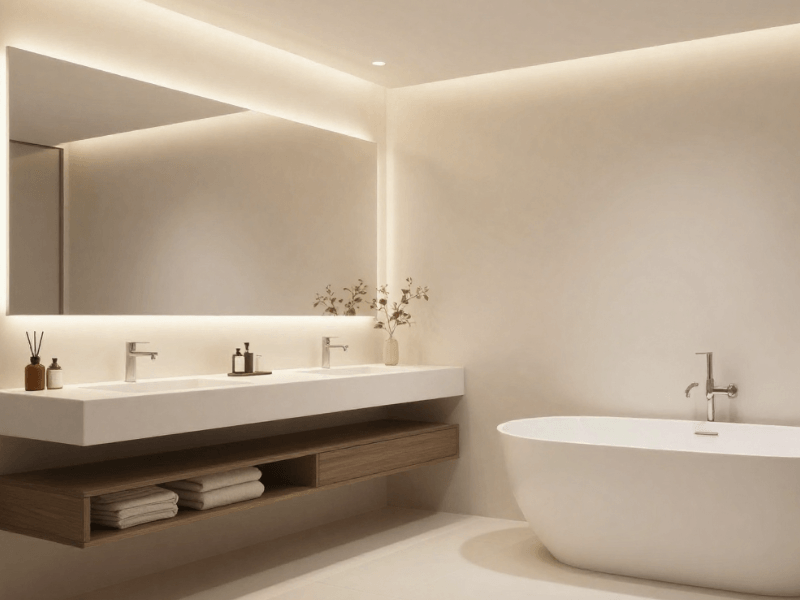
LED bathroom mirrors provide clear, even illumination across your face. With light shining directly on your face, the harsh shadows from the ceiling lights are reduced or eliminated.
When choosing one, consider the mirror's size, lighting distribution, and whether it provides enough illumination for your usual routine.
Shower and Bath Areas
Not all shower and bath areas are made the same. That is why layout matters here as much as lighting. You might have a shower screen, recessed enclosure, or overhead structure that can affect how much light reaches the space.
If you only have a fitting that illuminates the middle of the bathroom, then showering and bathing might end up being a little dim. Consider the fitting's position and whether its light reaches these areas.
Or, better yet, install lights directly above where you need them. But that means brightness won’t be the only consideration, since water and moisture will be present.
That’s where bathroom lighting IP ratings and zones come in.
Depending on which bathroom zone you’re installing your lights, the IP rating requirement changes. The more exposure they have, the higher the rating needed.
Relaxation Lighting for Evening Use
Your bathroom doesn't need to operate at full brightness every time you use it.
In the morning, you might want clear, practical illumination for getting ready. But in the evening, a softer light setting can make the same room feel more comfortable, especially if you’re looking to have a relaxing bath or a quieter nighttime routine.
You can do this with lower-level ambient lighting, dimmable fittings, and separate lighting layers. The added controls give your lighting setup flexibility.
Now, for the colour temperature: nothing says “relaxing” like warm white lighting. It helps create a softer atmosphere that’s easy on the eyes. Use it with other layers of light throughout the space for maximum spa vibe.

How Many Lumens Do You Need in a Bathroom?
When talking about brightness, you need to look at lumens. That’s the measure of how much light a fitting produces, a.k.a. Brightness. More lumens mean more light output, which means brighter light.
But how many do you actually need?
As a general guideline, some bathroom lighting guides suggest about 50-75 lumens per square foot. Total recommended output for a medium-sized bathroom (60-80 sq. ft.) is also around 4,000-6,000 lumens.
These figures can vary because they don't always account for the same things. Some refer to the combined output of all fittings, while others focus on general illumination or particular areas of the room.
You also need to consider ceiling height, layout, surface colours, and lighting arrangements.
So, treat the numbers more as planning references rather than fixed requirements.
The following table provides a practical framework for deciding where to start.

Why Bathroom Size Isn't the Only Factor
Size does matter… but they don't tell the whole story.
Two bathrooms with the same dimensions can feel completely different depending on their natural light, ceiling height, surfaces, and layout.
Consider these four before locking in your lighting plan.
Natural Light
A bathroom with no natural light will need a different lighting setup than one with a generous window.
A windowless bathroom needs artificial light to provide the room's entire illumination, day in and out. That’s why you'll need to pay closer attention to coverage and fitting positions.
The latter may receive plenty of daylight during the morning and afternoon. This can reduce how much artificial lighting you need during those hours.
However, natural light changes throughout the day. It’s also affected by the changing weather. In the UK, winter mornings and evenings, especially, can be gloomy.
Ceiling Height
This affects light spread.
In a bathroom with a lower ceiling, light fittings are closer to the surfaces below them. Bathrooms with higher ceilings, by contrast, have lights positioned farther from the floor.
Beam angle and positioning, then, matter if you want more consistent coverage.
Wall and Surface Colours
Most of the time, a bathroom's brightness depends on your tile colour, wall paint, and other surfaces. Here’s what I mean:
Light-coloured walls, ceilings, and floors generally reflect more light, helping it spread around the space. Darker surfaces tend to absorb more light, which can make the room feel, well, darker.
Naturally, lighting will differ for each one.
Also be careful with glossy surfaces, as they can reflect light and create bright spots or reflections that can be uncomfortable or glaring.
Bathroom Layout
If all bathrooms are rectangular, positioning your lights will be more straightforward. But many are not.
Bathrooms with separate shower enclosures, recessed shelving, exposed columns, or a large vanity unit often need more than a single ceiling light.
Also consider where the basin, toilet, bath, shower, and mirror are located. Think about whether any of these features block light or create shadows.
Planning around the layout helps ensure that light reaches the places where you need it most.
Brightness vs Colour Temperature: They're Not the Same
When shopping for bathroom lighting, you’ll come across terms other than lumens. You'll also see watts, Kelvin ratings, and CRI values.
They each describe something different:
-
Lumens (lm): The amount of visible light produced by a fitting.
-
Kelvin (K): The colour appearance of the light, from warm to cool.
-
Watts (W): How much power is consumed.
-
CRI: How accurately an artificial light source reveals object colours.
It’s important to distinguish between each one, especially brightness and colour temperature. They are not the same thing!
Here's an easy example. Two LED lights can both produce 800 lumens, meaning they have approximately the same light output, but one might be 2700K (warm) and the other 4000K (natural).
Just because a light source appears warmer (yellowish) doesn’t mean it produces less light.
Warm White
Warm white (2700K-3000K) produces a softer, more golden appearance. It can work particularly well for evening relaxation lighting, creating a comfortable atmosphere around a bath or vanity area.
Natural White
At 4000K, natural white offers a balanced appearance. It sits between warm and cool lighting. It provides a clear look and is a practical option for everyday lighting.
Cool White
Cool white (5000K+) produces a crisper, more daylight-like appearance. They’re helpful for task-focused areas where clear visibility is important. This light also appears bluish.
Understanding how you’ll mostly use the bathroom can help you choose the right colour temperature for the space. CCT-adjustable lights are the most flexible option, letting you easily switch between different colour temperatures.
Brightness Isn't Just About Lumens
Three other factors deserve attention.
Beam Angle
Simply, this describes how widely light spreads. It can be narrow, meaning the light is concentrated in a smaller area, or wider, meaning the light is distributed across a broader space. The latter makes the light’s effect softer.
Two identical lights can have the same lumen output but different beam angles. Choose one based on the bathroom layout, ceiling height, and the area you want to illuminate.
Light Position
Guess which one works better:
-
A fitting with a modest lumen output positioned well vs
-
A super bright fitting installed in the wrong place
If you answered the first one, you’re right!
Think of the mirror example. Powerful ceiling lighting can cast shadows across your face, but add dedicated mirror lighting (usually with lower lumen output), and grooming and makeup sessions improve dramatically.
The same principle applies to shower recesses, corners, and areas beneath cabinets.
Glare
Excessively bright or poorly positioned lights can cause glare and related discomfort, such as eye fatigue.
Consider the fitting's design, beam direction, and position. Indirect lighting can be a good solution, especially for ambient and accent lighting.
Diffusers can also help create a softer, more comfortable light distribution.

Should Bathroom Lights Be Dimmable?
If you want to improve your lighting controls, adding a dimming function is a great start.
For example, in the morning, you might want brighter, clearer light for getting ready, while in the evening, a lower setting can create a softer atmosphere for bathing or using the bathroom at night.
You can do all that without adding new fittings.
However, not every LED fitting supports dimming. The light, dimmer switch, and driver must be compatible.
Make it a habit to always check the product specification before buying.
How to Work Out the Right Bathroom Lighting Plan
This isn’t rocket science. Here are a few practical steps to help you narrow down what you need.
Step 1: Measure the Bathroom
Start by measuring the room's length and width. Multiply them to get the floor area. For example, a bathroom measuring 2m by 3m has a floor area of 6 m².
This gives you a starting point for estimating the required amount of light.
Step 2: Identify the Main Tasks
Think about what happens in your bathroom on a typical day.
What’s the most common activity you do? Do you mainly use it for general washing and showering? How about shaving, makeup, and skincare? Is it a family bathroom used by people with different routines?
Write down the main activities and identify where they happen.
This should help you determine which needs dedicated task lighting and which can work with general lighting alone.
Step 3: Identify Dark Areas
Sometimes shadowy areas remain, even when the main lights are bright.
Pay particular attention to:
-
Shower recesses and enclosed areas
-
Corners away from the main ceiling fitting
-
Spaces beneath cabinets
-
Areas around mirrors and basins
-
Windowless sections (limited natural light)
These areas may need additional illumination.
Step 4: Decide Where Task Lighting Is Needed
Typical task lighting you need in the bathroom includes mirror lighting (often more useful around the basin) and a suitable fitting above a shower to address a poorly lit enclosure.
But keep in mind that not all darker areas need task lighting. Sometimes you just need to reposition your lights.
Step 5: Check the Fitting's IP Rating
We already touched on this a bit earlier.
An IP rating indicates the level of protection a fitting provides against solid objects and water. Different bathroom locations have different lighting requirements, so check each zone.
Never assume that every bathroom light is suitable for every position.
Step 6: Choose Colour Temperature and Controls
Finally, decide how you want the bathroom to look and feel.
Does warm white make more sense? Will natural white look better? Or would cool white suit the current interior design best?
Also consider whether dimming or adjustable colour temperature would make the space more versatile.
Common Bathroom Brightness Mistakes to Avoid
Here are some common bathroom lighting mistakes to watch out for.
1. Using One Very Bright Light for the Whole Bathroom
This might seem like the easy solution… but it’s not. You end up with brightly lit areas with harsh light while others remain in shadow.
The better approach? Consider the room's layout and distribute light where you need it.
2. Choosing Lights Based on Watts
This is the old way. Watts indicate energy consumption, not brightness. With modern LEDs, look for lumens.
Sometimes even lower-wattage LED lights can produce more lumens.
3. Assuming Higher Kelvin Means Brighter
A higher Kelvin rating means the light appears cooler, not brighter.
An 800-lumen warm white fitting and an 800-lumen cool white fitting have approximately the same light output, even though their appearance differs.
4. Making the Mirror Area an Afterthought
Your grooming area (typically above the sink) is one of the major zones of your bathroom. General lighting here usually gives you unwanted shadows under your eyes, chin, or other parts of the face.
An LED mirror is always a good addition. Plan this early.
5. Ignoring Glare
More light isn't always more comfortable.
Consider where fittings are positioned, how their beams are directed and whether they create unwanted reflections. Glossy surfaces might be doing you more harm than good.

Final Checklist: Is Your Bathroom Bright Enough?
Here’s a short checklist you can run through before buying your bathroom lights.
-
Can you move around comfortably without noticeable dark areas?
-
Can you clearly see your face in the mirror?
-
Are the shower and bath areas adequately illuminated?
-
Is light distributed evenly across the room?
-
Is the brightness comfortable rather than glaring?
-
Does the colour temperature suit how you use the bathroom?
-
Does every fitting have the correct IP rating for its location?
-
Would dimming or adjustable colour temperature make the space more versatile?
The biggest takeaway in this guide is this: Don't choose bathroom lights based on lumens alone. Consider room size, positioning, beam angle, natural light, and the activities taking place in each area.
A thoughtfully planned combination of general and task lighting can make a bathroom feel brighter, more comfortable and easier to use without flooding every corner with excessive light.
If you’re ready to improve your bathroom lighting, explore Simple Lighting's bathroom lighting range to find options that suit your space and how you use it.


0 comments