
Garden lighting has come a long way from tangled cables and that one outdoor socket you’re only 69% sure is waterproof. 2026 has seen solar garden lights becoming brighter, smarter, and far less likely to leave you muttering in the rain. Even with the UK’s unpredictable weather, modern solar tech performs surprisingly well.
Whether you’re lighting a small patio or going all out on your garden, you’ll always have a solar option. In this guide, we’ll show what’s worth your money and time, helping you get a reliable glow without quietly inflating your energy bill.
Why Solar Garden Lights Are Worth It in 2026
Solar garden lights have gone from “Nice idea, shame it doesn’t work!” to something you can actually lean on. Here’s why:
Better Technology
Solar lights today are no longer the dim, flickery afterthoughts they used to be. Panels are more efficient, brightness is stronger, and batteries last long enough to get you through the evening. Even in the UK (where sunshine tends to make only the briefest cameos), modern systems are built to work with limited daylight, not against it.
Lower Running Costs
Once they’re in, solar lights cost you virtually nothing to run. That means no complicated wiring, constant visits from an electrician, and slow creep on your electricity bill. With energy prices currently running amok nationwide, solar lighting is one of the few upgrades that won’t come biting in the ass later.
Environmental Friendliness
If you’re trying to be a bit more energy-conscious (without turning your home into a full sustainability project), solar lights are an easy choice. They’ll help you cut down your reliance on mains power while still doing a proper job. Minimal effort, noticeable difference.
Better Function and Aesthetics
Good solar lighting can make your garden feel intentional rather than just… there. Your paths will be safer, your patios actually usable after sunset, and the entire space will look far more put-together. Plus, some options won’t make you choose between something practical and something that doesn’t look like it came from a bargain bin.
How to Choose Solar Garden Lights (UK Buying Guide)
Not all solar lights are created equal. Some can help you realise your home and garden outdoor lighting ideas. Then there are ones that exist purely to disappoint you.
Solar Panel Efficiency and UK Weather
In the UK, panel efficiency isn’t optional—it’s everything. Monocrystalline panels usually fare better in low-light conditions than polycrystalline ones. This really matters when the sun is doing its usual disappearing act.
If your garden doesn’t get full sun all day (which is nothing new in the UK), look for lights designed to handle partial or indirect light. Otherwise, you’ll end up with something that still technically works (usually not when you need it to).
Light Brightness & Coverage (Lumens & Beam)
Lumens tell you how bright a light actually is (it also happens to be the part where customer expectations often fall apart). Decorative lights (5 to 50 lumens) are great for ambience but won’t help you see much. Path lights usually sit around 50 to 150 lumens, while anything for security or larger areas should be at least 200.
Beam angle matters, too! Narrow beams highlight specific features, while wider ones spread light across a larger space. Get this wrong, and you’ll either end up with spotlight drama or a barely-there glow.
Battery Life, Charging Time & Autonomy
Battery quality is what separates “Works fine!” from “Why is this already off?” Lithium-ion batteries are the better option in 2026. They offer longer life and more consistent performance. That being said, NiMH batteries will still pop out if you’re looking for cheaper models (which explains a lot).
A decent solar light should last around 6 to 10 hours on a good day. If it taps out before bedtime, then it’s obviously not doing its job.
Weatherproofing & Durability (IP Ratings)
UK weather can be harsh, so your solar lights shouldn’t be snowflakes. IP65 is the minimum you should consider; it can offer protection against rain and dust. But if you want something more robust, IP67 can provide that extra resilience.
Here’s another thing worth noting: cheap materials age like milk outdoors. If the product you bought already feels flimsy out of the box, consider returning or binning it. It won’t magically improve after a few weeks of wind and rain.
Style, Design & Use Case
Current solar lighting options can cover everything, be it subtle pathway markers, decorative lanterns, or even fairy lights. To achieve the best look, avoid overdoing any one type.
Install path lights for safety, add feature lights for highlights, and then throw in ambient lighting for atmosphere. This mix can work wonders for your garden. In contrast, going all-in on one style usually looks enthusiastic, but not in a good way.

Best Solar Garden Lights in the UK for 2026
If you’d rather skip the trial-and-error part (and the inevitable disappointment that usually comes with it), then consider these products from Simple Lighting:
Pack of 6 Solar LED String Lights
If you want atmosphere over brute brightness, this is a great choice. These black lantern-style string lights are built for ambience, not interrogation-level lighting. It will go well with your patios and pergolas (basically, anywhere you’d like your garden to look intentionally cosy rather than aggressively lit).
Key Specs & Ideal Use
- Set of 6 lantern-style LEDs
- Solar-powered with a rechargeable panel
- IP44 rated (splash resistant)
- Best for patios, seating areas, and decorative features
Pros
- Visually pleasing design with a black finish
- Rechargeable solar panels
- No wiring, quick install
Cons
- Non-dimmable
- Lower IP rating compared to other heavy-duty options.
Pack of 3 Bunbury Colour Changing LED Solar Stake Lights
These are the “make it look like you tried” lights. The colour-changing feature adds personality without going full theme park. They’ll work well with your pathways, borders, and darker corners.
Key Specs & Ideal Use
- Pack of 3 solar stake lights
- Colour-changing LED output
- Ground stake installation
- Ideal for pathways, borders, and garden accents
Pros
- Adds visual interest without overdoing it
- Easy to reposition and install
- Good middle ground between decorative and practical
Cons
- Not as bright as other dedicated pathway lighting
- Colour mode may not suit every garden style
Pack of 3 Dubbo Stainless Steel LED Solar Bollard Light
If you want something that actually lights the ground properly (and doesn’t look flimsy doing it), this is your pick. These stainless steel bollard lights are built for durability first, aesthetics second. And luckily, they manage both!
Key Specs & Ideal Use
- Pack of 3 bollard-style solar lights
- Stainless steel housing for durability
- Pathway-focused downward lighting
- Best for driveways, paths, and entrances
Pros
- More durable than plastic alternatives
- Cleaner, more modern look
- Reliable performance in outdoor conditions
Cons
- Less decorative than other options
- Slightly more utilitarian in design
Solar Garden Lighting Ideas for UK Gardens
Good lighting is not just about seeing where you’re going. It’s about making your garden look like you planned it, not like you placed a few lights and hoped for the best.
Pathways & Driveways That Actually Guide You
Path lighting should feel intentional, not like a guessing game. Space lights evenly along paths or driveways so people can walk without doing that awkward half-step shuffle in the dark. Keep the height and brightness consistent for a cleaner look. Random spacing creates confusing patches of light and shadow, which is somehow worse than no lighting at all.
Patio Lighting That Feels Like a Space
Patios need layered lighting. A single dim light will not magically create ambience; it just makes everything look slightly underwhelming. Combine softer lights like string lights or lanterns with a few brighter fixtures so you can actually see what you’re doing. The goal is relaxed, not “squinting at your drink to check what it is.”
Highlight Features (Without Overdoing It)
Feature lighting works best when you show a bit of restraint. Highlight a few key elements like plants, walls, or a pergola, and let the rest sit in the background. If everything is lit, nothing stands out. It stops being a feature and starts looking like a garden showroom.
Decking, Pergolas & Vertical Spaces
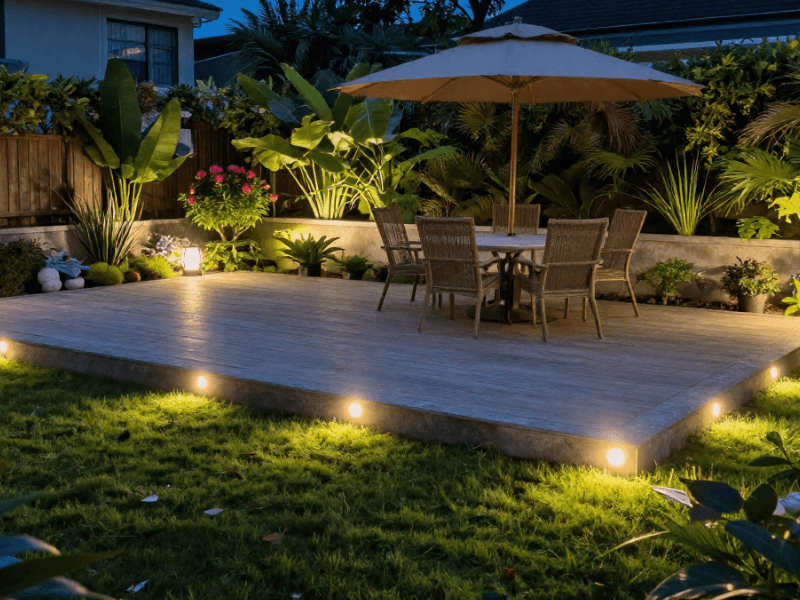
Not all lighting needs to be on the ground. Adding lights to fences, pergolas, or deck edges creates depth and makes the space feel more finished. It also avoids that flat, one-level look where everything blends together. A bit of height goes a long way.
Seasonal Setups That Actually Make Sense
Your lighting can change with the seasons. Warmer tones suit summer evenings, while brighter, cooler lighting is more useful in winter when it gets dark at what feels like mid-afternoon. You don’t need a full redesign; just a few swaps can keep things practical and not permanently stuck in one mood.
Installation & Maintenance Tips
Solar lights should be low-effort, not no-effort. A few small tweaks make the difference between “Works perfectly” and “Why is this barely on?”
Put Them Near the Sun
This sounds obvious, but it’s where most setups go wrong. Solar panels need daylight, not vibes or good intentions. Avoid placing them under trees, deep shade, or tucked behind fences where sunlight barely reaches. If a spot only gets a polite hint of sun, expect equally polite lighting at night.
Angle & Positioning Matter More Than You Think
It’s not just about location, it’s about direction. Tilt panels towards the sun where possible, and avoid angles that block exposure. Even a small adjustment can improve charging performance. Set them up properly once, and you won’t have to keep wondering why one light is thriving while the others have given up.
Keep the Panels Clean
Solar panels don’t need much maintenance, but they do need to be visible. Dirt, dust, and the usual outdoor buildup can reduce efficiency more than you’d expect. A quick wipe every few weeks is enough. It takes less time than scrolling through your phone, and it actually solves a problem.
Winter Will Test Your Setup
Shorter days mean less charging time; there’s no way around that. Higher-quality lights handle this better, but placement becomes even more important. If your lights struggled in summer, winter won’t be kind to them. Adjust expectations or upgrade accordingly.
Battery Life & Replacements
Solar batteries don’t last forever, no matter what the box suggests. Most will need replacing after a couple of years. If your lights suddenly start fading early or cutting out, it’s usually the battery, not the whole unit. Choosing models with replaceable batteries saves you from throwing everything out when one part gives up.
FAQs
Do Solar Lights Work in Winter?
Yes, but manage your expectations. With shorter days and less sunlight, performance will dip. Better-quality lights designed for low-light conditions will still give you a decent run time, while cheaper ones may tap out early. If they struggled in summer, winter will absolutely expose them.
How Long Does a Full Charge Last?
Most decent solar lights run for around 6 to 10 hours on a full charge. That’s enough to get you through the evening, not necessarily until sunrise. If yours are switching off suspiciously early, they’re either not getting enough sunlight during the day or weren’t particularly good to begin with.
Can I Replace the Battery?
In many cases, yes—and it’s worth checking before you buy. Batteries typically last a couple of years, then performance drops off. Replacing them is far cheaper than replacing the entire light, and far less annoying once you realise that’s all that was wrong.
Are Solar Lights Waterproof?
Most are water-resistant, not indestructible. Look for an IP65 rating or higher for reliable outdoor use in UK weather. They’ll handle rain just fine, but that doesn’t mean they’re meant to live at the bottom of a puddle. Treat them like outdoor lights, not marine equipment.

Light Up Your Garden Smarter in 2026
Solar garden lights in 2026 are no longer the “nice idea, poor execution” they used to be. With better panels, stronger batteries, and more reliable output, they’ve become a genuinely practical way to light your outdoor space.
It all comes down to making good choices. The right lights, placed properly, will give you consistent performance and a setup that actually looks intentional. The wrong ones will leave you with a dim glow and a mild sense of regret. A bit of planning goes a long way.
If you’re ready to upgrade, it’s worth sticking with options that are built for UK conditions. Simple Lighting offers a solid range of solar garden lights that balance durability, performance, and design. Skip the trial and error and visit our site today!
If you feel like you need more outdoor lighting insights, check out The Complete Guide to Garden Lighting.


0 comments