








Did you buy your LED strip lights thinking, “Surely any power supply that fits will work, right?”
This might come as a shocker: no.
The right choice depends on the strip you are powering, where it will be installed, and how you want the lighting to work.
Before buying a driver, you need to know the LED strip voltage, total wattage, and length. You also need to consider where the driver will sit, whether you want dimming, and whether it will be plugged into a socket or hardwired into the installation.
That might sound like a long list, but if you know which LED driver to look for, it becomes much easier.
In this guide, we will cover the main types of LED drivers and which applications they’re best suited for. By the end, you’ll learn how to size a driver, when you might need more than one, and the common buying mistakes you need to avoid.
But before diving in, you might come across the terms LED driver, power supply, and transformer. People often use these terms interchangeably, but the right product depends on your lighting system's requirements.
Start Here: What Type of LED Driver Do You Need?
Rather than starting with a list of drivers, start with your LED strip and installation.
Here’s a simple selection process that can help narrow things down:
-
Step 1: Match the voltage
-
Step 2: Calculate the wattage
-
Step 3: Choose the installation type
-
Step 4: Select dimming and control compatibility
-
Step 5: Check the environment
Cover these five points, and choosing a suitable driver will not be a guessing game.
Check Whether Your LED Strip Is 12V or 24V
Your LED strip can either be 12V or 24V. Whatever your strip’s voltage is, the driver must match it.
It is as simple as:
-
12V LED strip → Compatible 12V LED driver
-
24V LED strip → Compatible 24V LED driver
WARNING: Do not use a 12V driver for a 24V strip, and a 24V driver for a 12V strip. Otherwise, you risk damaging your strips and power supply.
You can usually find the strip voltage in the product specifications, packaging, or product description. Check this before purchasing the driver.
12V and 24V LED strips can look similar, but they require different power supplies.
Calculate How Much Wattage Your LED Strip Needs
The next step is to work out how much power the strip needs.
The math is fairly easy too:
LED strip wattage per metre x total strip length = total wattage required
(The manufacturer should provide the wattage per metre. Check product specifications.)
For example, if you have a 5m LED strip rated at 10W per metre:
10W x 5m = 50W
Your connected load is therefore 50W.
This means the driver you need should be at least 50W. A good rule of thumb is to give a 10% to 20% safety margin to prevent the driver from running on its limit for long periods.
Always calculate the load before getting the driver, especially for installations involving multiple runs.
Decide Where the Driver Will Be Installed
There are all sorts of driver builds. Some come smaller, and some are larger. Some need more protection than others. That’s why the installation location matters when choosing the right driver.
Consider accessibility, ventilation, and environmental protection before deciding where the driver will go.
Common locations include:
-
Inside kitchen cabinets
-
Above kitchen units
-
Inside wardrobes
-
Behind furniture
-
In ceilings
-
Bathrooms
-
Outdoor or damp areas
When space is limited, a compact driver may be useful. For outdoor installations, you’ll want a driver with a higher IP rating (preferably IP65 if you’re installing in the open).
Whatever you choose, install the driver in a suitable location where it can operate safely and remain accessible for future maintenance.
The Best LED Driver Types for Different Strip Lighting Setups
Alright, now that all the important things are out of the way, it’s time to start looking at the type of driver that best fits your project.
To do that, ask yourself, “What does my installation need?”
Best Plug-In LED Drivers for Simple LED Strip Installations
If you’re looking to DIY your installation and you don’t want to work on wiring your strips, or you don’t have the skills and knowledge to do so, plug-in LED drivers are a straightforward choice.
All you need is a standard socket available where you’re installing the strips.
This type of LED driver can be very useful for smaller domestic projects or rental properties where hardwiring is not an option.
Here’s when a plug-in driver can make sense:
-
A standard socket is available
-
You want a quick and simple installation
-
The strip is being used for a smaller domestic project
-
Hardwiring is unnecessary or not available
Again, check the voltage and the total wattage of the run, and make sure the driver can accommodate both.
It is also worth checking the connector type and cable length. A driver with the correct electrical specifications is not particularly helpful if the cable cannot reach the installation.
If you really don’t want to worry about anything, LED strip lighting kits are available and can be installed right out of the box. These kits eliminate the guesswork of finding compatible components, since the whole kit is designed to work seamlessly together.
Best Hardwired LED Drivers for Permanent Installations
Looking for a more permanent solution? A hardwired LED driver may be the better option. It can also be cleaner and has a more “built-in” look and feel than the plug-in drivers.
These drivers are well suited to projects where the power supply needs to be concealed. Under cabinet lighting, kitchen lighting, shelving, and display lighting are all examples of their useful applications.
Choose hardwired drivers if you’re looking for:
-
A cleaner installation
-
Easier cable concealment
-
A more integrated lighting setup
-
Support for larger installations, depending on the model
They can be particularly useful when there is no convenient socket near the installation area or when visible cables would spoil the finished look.
However, hardwiring a driver involves working with the mains supply. This means that unless you have the proper qualifications, a certified professional should carry out the connection work.

Best Dimmable LED Drivers for Adjustable Strip Lighting
Some nights, you just want softer light to wind down after a long day. Other nights you need them bright for hosting friends or family. That's where a dimmable LED driver comes in.
You might see an LED strip light that says “dimmable” on its pack or in the product name/description, and think, “Yup, that’s all I need.” It’s not. The complete lighting system needs to be compatible.
This means you need:
-
The LED driver
-
The LED strip
-
The dimming method
-
Any compatible controller or dimmer
A dimmable LED strip doesn't automatically mean any driver and dimmer combination will work with it. Always check the manufacturer's specifications and make sure the components can work together.
Depending on how you want to control the lights, you may use a compatible dimmable driver, LED dimmer, or controller to adjust brightness.
So, first decide on your preferred control method. This can save you from ending up with a perfectly capable power supply that does not support what you had in mind.
Best Waterproof LED Drivers for Outdoor and Damp Areas
Here’s a common mistake people make: they get outdoor-rated LED strip lights for their patio or garden lighting project but forget that the other components also need to be outdoor-rated.
The driver and the rest of the installation also need to be appropriate for the environment!
That is where IP ratings come into play. And it’s one you shouldn’t take lightly.
If you aren’t familiar, an IP rating indicates the level of protection provided against dust and water ingress. The correct rating depends on where and how the equipment will be installed.
The first thing to do is not to assume that an outdoor LED strip can simply be paired with any power supply. An indoor driver will most likely not have the protection needed for an exposed outdoor location.
The same principle applies to connections, cables, and other electrical components. The LED strip shouldn't be the only component suited to the environment you’re installing it in.
If you are installing lighting somewhere exposed to rain, splashes, or moisture, at least an IP65 is a good starting point.
“Why can’t I just get the highest rating just to be on the safe side?”
You certainly can! But do you have to? Probably not. A higher IP rating typically means more expensive components due to the added protection. That could mean extra cost for protection you do not need.
Check the relevant IP ratings and installation requirements carefully before getting started.
Best High-Wattage LED Drivers for Larger Strip Lighting Projects
Longer or more complicated installations need a little more planning.
One might think that installing LED strips to a long kitchen run, commercial display, or shelving system requires a single LED driver with a large capacity. Truth is, that’s not always the case.
Sure, in these situations, adding together the wattage of all the strips is essential.
For example, if three sections require 30W, 40W, and 50W respectively. But that does not necessarily mean you need a 120W driver. Depending on the installation, separate drivers may provide a more practical solution.
You’ll have to consider layout, driver position, and control method (for dimming or colour controls).
Voltage drop can also become a consideration with longer LED strip installations. As the electrical run gets longer, the voltage available along the strip can reduce, potentially affecting brightness and consistency.
This is one reason 24V LED strips are often useful for longer runs, while 12V options are preferred for shorter installations.
For larger projects, consider the layout first rather than simply choosing the highest-wattage driver available.
LED Driver Comparison: Which Type Is Best for You?

The "best" option depends on your setup. A small cabinet light may only need a compact plug-in driver, while a larger kitchen installation could benefit from a concealed driver with dimming controls.
How to Size an LED Driver for Your Strip Lights
Choosing the right driver wattage is easier when you break it into a few simple steps.
Step 1: Find the Strip's Wattage Per Metre
Always do this first. This information should usually be listed in the:
-
Product specification
-
Product description
-
Packaging
-
Technical data
-
Product name (sometimes)
For example, a strip might be rated at 8W per metre.
Step 2: Multiply It by the Total Length
Since the wattage count is per metre, all you have to do is multiply it by the length of the strip you’re using.
For a 4m strip rated at 8W per metre:
8W/m x 4m = 32W
Your total connected load is 32W.
If you’re connecting multiple strips to one driver, calculate the wattage of each section and add the results together.
Step 3: Choose a Driver With Enough Capacity
The driver needs to safely support the total connected load. By “safely,” I mean adding an extra 10% to 20% safety margin to account for power surges and prevent the driver from running at full capacity all the time.
Using the example above, a 50W LED driver would be the ideal choice rather than one rated exactly 32W.
Finally, avoid choosing a driver purely because its wattage figure looks large without checking what the voltage is and its compatible control method (if relevant).
Step 4: Check the Output Voltage One More Time
Before placing the order, check the voltage again. Trust me, it pays to be extra careful.
This is the rule worth putting on a sticky note:
The driver's output voltage must match the LED strip's required input voltage.
For our example above, a 100W driver rated at 12V won’t be useful if your strips are rated at 24V.
The rule is simple. If your strip is 24V, choose a compatible 24V driver. If it is 12V, choose a compatible 12V driver.
It’s not complicated, but it can be easy to forget.

Do You Need One LED Driver or Multiple Drivers?
Quick answer: It depends on your layout.
One driver can power several LED strips, but only when the voltage is correct, the total wattage is within the driver’s capacity, and the wiring arrangement allows it.
Let’s look at it in detail.
When One Driver Can Power Multiple LED Strips
The steps are still the same. First, calculate the total load of each strip.
For example:
Strip 1 = 20W
Strip 2 = 25W
Strip 3 = 30W
Then get the combined load of all the strips:
Total = 75W
This means a 100W LED driver should be a safe choice to connect all three strips, provided they can all reach it.
This brings us to the other point: Don't assume that multiple strips should always share one driver. The physical layout and control requirements matter too.
When Multiple Drivers May Be Better
If you have very long installations, having separate drivers might make more sense. This also applies to installations spanning different rooms or independently controlled lighting zones.
Long installations are also prone to voltage drops, so dividing sections into different power points is a good way to prevent that. Because technically, the “long run” is now a collection of multiple short runs.
For example, a kitchen might have one strip beneath the cabinets and another inside display shelving. If you’re all right with both of them connected to a single power source, which means both switch on at the same time, then by all means use a single driver.
But if the two sections need to be controlled independently, separate power and control arrangements could make both lights easier to manage.
Installation can be a bit of a challenge, especially with complex RGB or CCT systems, so the key here is to plan the wiring and control system before buying the driver. A little planning can save you a lot of head-scratching later.
Just make sure you know how to connect your LED strips to the power supply properly, and the whole setup should come out nicely.
Common LED Driver Buying Mistakes to Avoid
Choosing the Wrong Voltage
I can’t stress this enough. This is one of the most serious mistakes to avoid.
A 12V strip needs a compatible 12V driver, while a 24V strip needs a compatible 24V driver. That’s the golden rule. Always check the strip specification before selecting the power supply.
Buying a Driver With Too Little Wattage
If your connected strips require more power than the driver can provide, the driver is not suitable for the installation. Simple as that. There’s no “Maybe it will still work.”
Calculate the total load you’re going to connect to the driver rather than guessing based on the length of just one section.
Get a driver with about 20% more capacity than the total load.
Choosing a Driver Based on Wattage Alone
Wattage is only part of the equation. Other important factors include voltage, dimming compatibility, installation type, connection method, and environmental rating.
A driver with enough capacity can still be the wrong choice for your project if you get the other factors wrong.
Forgetting About Dimming Compatibility
A dimmable strip does not automatically make every driver and dimmer combination compatible. Check the complete system before buying. This includes the driver, strip, dimmer and any controller being used.
Using an Indoor Driver in an Unsuitable Environment
An indoor driver is only meant to be used… well, indoors. If you’re looking to install your LES strip lights outdoors, you will need a driver (and other components) rated for outdoor use.
Check the driver's IP rating and installation requirements
Hiding the Driver Where It Cannot Be Accessed
It can be tempting to tuck the driver into the deepest, darkest corner of a cabinet and forget about it… until it needs to be serviced or replaced. Choose a location that keeps the installation neat while still allowing reasonable access.
This applies to other components as well.
Best LED Driver for Common Strip Lighting Projects
Here's how to approach some of the most common setups.
Best LED Driver for Under Cabinet Strip Lighting
Compact and discreet is usually what you’ll want here.
A plug-in driver can work well where there is an accessible socket, making the installation relatively simple. But if you’re looking for a more permanent solution, a hardwired driver may offer a cleaner finish, as long as you keep cables out of sight.
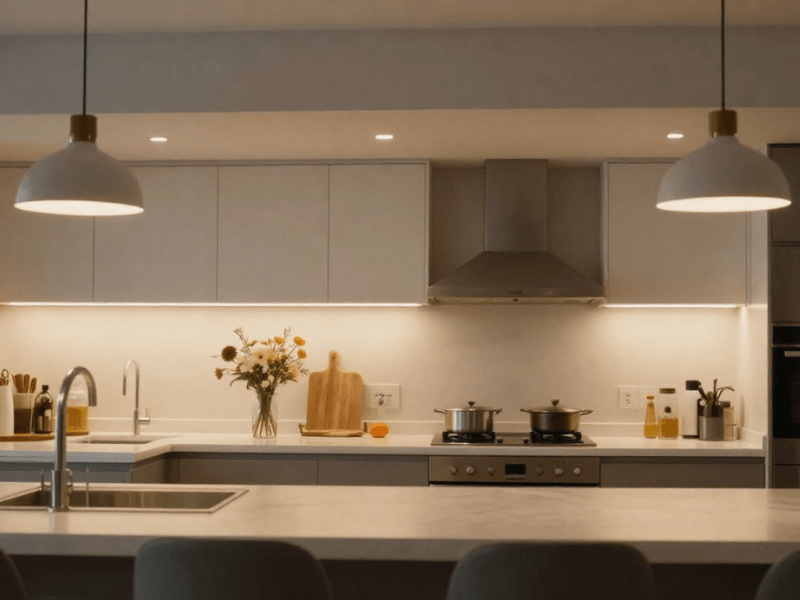
You might also want to consider dimming. You can have bright task lighting while cooking but softer illumination later in the evening.
Avoid burying the driver somewhere impossible to reach. Always consider future access.
Best LED Driver for Kitchen LED Strip Lights
This can be a demanding project, especially if runs are longer and you have several lighting zones.
Start with the total wattage, then consider where the driver will be positioned and how the different lighting areas will be controlled.
You may also need to account for:
-
Total wattage
-
Driver placement
-
Dimming
-
Controllers
-
Multiple runs
-
Cable routing
Remember that in any installation, careful planning can make a massive difference.
Best LED Driver for RGB Strip Lights
RGB LED strip lighting adds colour control to the equation, which means the driver is only one part of the system. A compatible controller is added into the setup:
Power Supply → RGB Controller → RGB LED Strip
Just remember that:
-
The power supply needs to be suitable for the strip's voltage and total load
-
The controller needs to be compatible with the RGB strip and provide the type of control you want.
Best LED Driver for Outdoor LED Strip Lights
Here, it’s all about environmental protection.
Start by checking the required IP rating for the driver and the rest of the installation. Figure out:
-
Will the driver be sheltered? Or will it be exposed to the rain and other elements?
A good starting point is getting a driver with an IP65 rating. Get progressively higher ratings depending on your installation.
Remember that “Outdoor LED Strip” on the packaging does not mean only the strips need outdoor protection.

Final Thoughts: Choosing the Best LED Driver for Your Strip Lighting
What do you know? Size isn’t always what matters. Especially not when it comes to your LED drivers.
Before buying, don’t just focus on capacity (wattage). Three other key priorities matter:
-
Correct voltage
-
Suitable features (dimming and control)
-
Appropriate installation protection
Choosing the right driver becomes much simpler when you know what to look for… and what to look out for.
If you’re looking to get your LED strip lighting on the right track, follow everything we discussed in this guide and check out Simple Lighting’s wide range of LED strips, drivers, connectors, and accessories.


0 comments