

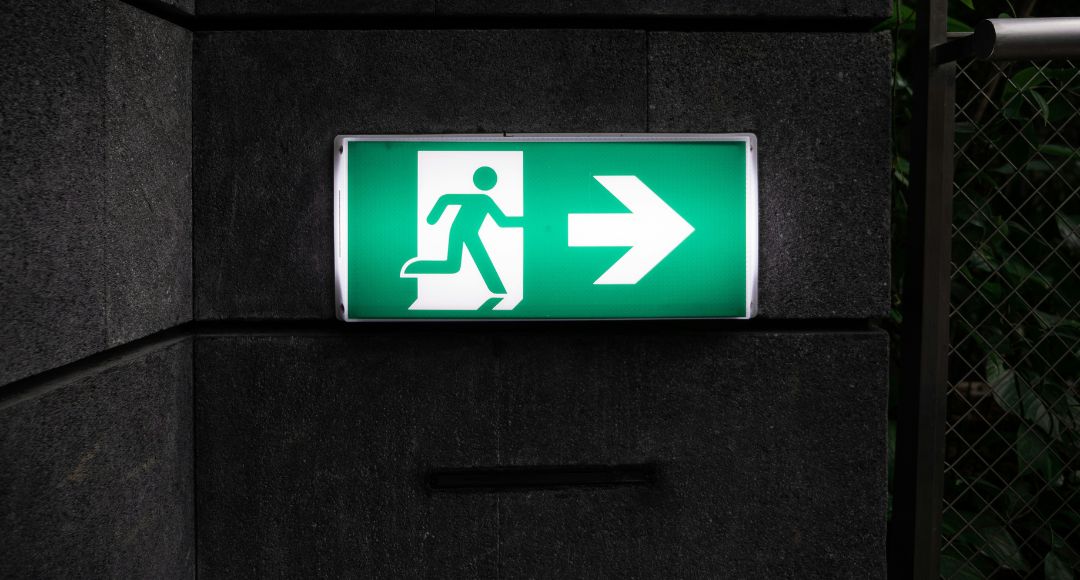
In an emergency, when in a building, do you stop and pause to check and analyse floor plans for the fastest exit route, or do you look for glowing exit signs instead? Most probably the latter, right?
That’s why exit sign placement is crucial. If those signs are poorly placed, unclear, or invisible at the critical moment, the safest escape route can become a guessing game. Exit sign placement is not just a technical detail, but a life safety decision.
If you’re a landlord or a property owner, then you’re in the right place. In this guide, we’ll break down the rules and best practices for exit sign placement in the UK.
We’ll discuss where exit signs belong, how they should be seen, and how to avoid the common mistakes that lead to inspection failures.
Why Exit Sign Placement Is Critical for Safety and Compliance
Exit signs only work if people can see them and immediately understand what they are being told to do.
In emergency and evacuation situations, conditions are rarely calm. Alarms are sounding, people are moving quickly, and decision-making becomes reactive rather than proactive.
In offices, schools, retail spaces, and public buildings, many occupants may be unfamiliar with the layout. Visitors, especially, do not know which doors are final exits and which lead to cupboards, plant rooms, or dead ends.
Smoke and power failure further complicate matters. Panic can set in as visibility drops, especially in corridors and stairwells. Even a well-designed escape route becomes ineffective if its signage disappears into the background or is hidden by architectural features.
Assessment and role of exit signs
From a compliance perspective, exit sign placement is one of the most commonly flagged issues during fire risk assessments and emergency lighting inspections.
Signs may be present, but they are not positioned to provide continuous guidance. Inspectors regularly note missing signs at junctions, arrows pointing the wrong way, or signs mounted too high to be noticed.
Exit signage is not a decorative add-on. It’s a core part of the building’s overall escape strategy, working alongside emergency lighting, fire doors, and alarm systems. When placed correctly, exit signs reduce hesitation, prevent delay, and help people move confidently toward safety.
What UK Regulations Say About Exit Sign Placement
UK guidance on exit signage focuses on outcomes: people must be able to find their way out quickly and safely.
BS 5266 and Emergency Escape Signage
BS 5266 is the key British standard covering emergency lighting and escape signage. Its purpose is simple: To ensure that escape routes are clearly visible and usable when normal lighting fails.
Instead of specifying exact distances for every building type, the standard focuses on clear guiding principles. Exit signs should clearly (and continuously) lead people from any point on the escape route to a place of safety. At no point should anyone be left unsure which direction to take.
This means signage must appear at all critical decision points, such as changes in direction, intersections, and level changes. Signs should be visible, clear, and consistent in design and arrow logic.
The standard also links exit signage closely with emergency lighting. Signs must remain visible even during a power failure, either through maintained illumination or emergency backup.
Some bulkhead lights installed near the exits have emergency functions that enhance sign visibility.
Building Regulations and the Fire Safety Order
Exit sign placement is also reinforced by Building Regulations and the Regulatory Reform (Fire Safety) Order.
These frameworks tie signage directly to escape routes and emergency lighting. If a route is designated as an escape route, it must be clearly marked and adequately lit.
What’s considered inadequate?
- A sign without sufficient lighting
- A lighting with unclear signage
These also legally require the “Responsible Person,” who may be the building owner, employer, managing agent, or facilities manager, to ensure that fire safety measures, including exit signage, are functioning and well-maintained.
Failure to provide adequate signage can lead to enforcement action, failed inspections, and, in serious cases, prosecution. More importantly, it increases the safety risk to occupants during an emergency.
Where Exit Signs Must Be Installed
Simply put, exit signs should be installed at every point where a person might hesitate or make a wrong decision during an emergency. Some examples are:
Above final exits – Every final exit door leading directly outdoors or to a place of safety should be clearly marked with an exit sign.
At changes in direction – Whenever an escape route changes direction, an exit sign with an arrow should clearly indicate the correct path. Without this, occupants may continue straight ahead into danger or a dead end.
Along long corridors – Long, empty stretches with a single sign at the end can feel disorienting in low-visibility conditions.
At intersections and junctions – Where corridors intersect, exit signs are essential. These are high-risk decision points, especially in offices and public buildings with complex layouts.
Near changes in floor level – Stairs, ramps, and changes in level should be clearly marked. This confirms that the route continues in the intended direction.
The guiding principle is continuity. From the moment someone begins evacuating, they should be able to follow a chain of signs to safety.
Exit Sign Visibility Rules You Can’t Ignore
Placement alone is not enough. A correctly positioned sign that cannot be seen or understood is, effectively, for lack of a better word, useless.
Viewing Distance and Sign Size
Exit signs must be large enough to be read from certain distances.
In small rooms or short corridors, standard-sized signs are usually sufficient. In large open-plan offices, warehouses, or retail spaces, these signs quickly become ineffective because their size mismatches the space.
This is a common issue in buildings that have been reconfigured or extended over time. A sign that once worked perfectly may now be too small for the space it serves.
Height, Angle, and Line of Sight
Exit signs should generally be mounted above doors or at a height where they naturally fall within a person’s field of view. Mounting signs too high can make them easy to miss, especially when people are moving quickly.
When installing exit signs, aim for a clear line of sight. Signs should not be obscured by ducting, cable trays, shelving, or open doors. A building with a door that covers the sign when opened can easily fail an inspection.
Signs should also be visible from all directions. If a corridor leads toward a junction, the sign should be readable before a person reaches that point, not only when standing directly beneath it.

Maintained vs Non-Maintained Exit Signs
Exit signage and emergency lighting are inseparable. (Or at least they should be.) There are two types you need to consider.
Maintained exit signs remain illuminated at all times, while non-maintained signs only light up during a power failure. In many environments, maintained exit signs are the preferred or required option.
Public-facing buildings such as shops, hospitals, cinemas, and transport hubs often rely on maintained signs to clearly mark exits, even in low ambient light.
Maintained signs also provide reassurance. Occupants can familiarise themselves with escape routes during normal operations, reducing confusion in an emergency.
Regardless of type, exit signs must remain visible when normal lighting fails. If a sign cannot be seen during a power outage, it fails to serve its purpose.
Common Exit Sign Placement Mistakes That Cause Inspection Failures
This might already have occurred to you, but you can have exit signs installed and still fail inspections. The cause? Placement errors.
1. Signs hidden above doors that open upward are a classic example. When the door opens, the sign disappears at the exact moment it is needed.
2. Incorrect arrow direction. An arrow pointing straight ahead when the route actually turns left can mislead occupants and undermine trust in the signage system.
3. Missing signs at junctions often occur in buildings that have been altered over time. New partitions are added, routes change, but signage is not updated accordingly.
4. Too few signs is also a problem. Relying on assumed knowledge, such as “everyone knows where the stairs are”, is not acceptable. Visitors and new staff do not share that familiarity.
5. Conflicting signage, where multiple signs point in different directions, can be just as dangerous as having no signage at all. In an emergency, confusion slows evacuation.
Inspectors commonly flag these issues because they are easy to miss in day-to-day use but critical during an evacuation.
Best Practices for Clear, Intuitive Escape Routes
Good exit signage is not just about following the rules. It’s also about good design. Here are the things you need to take note of to achieve a good exit signage installation.
1. Consistent arrow logic is essential. Once an arrow style and direction system is chosen, it should be applied throughout the building. Having a different signage style at every turn creates hesitation.
2. Visual continuity matters. Exit signs should feel like part of a single system, guiding occupants step by step from their starting point to the final exit.
3. Over-signage should be avoided. Too many signs can be as confusing as too few, especially if they compete for attention.
4. Exit signs should be integrated with the emergency lighting layout. Signs need sufficient illumination, and lighting should support their visibility, particularly in smoke-prone areas.
5. Take the environment into consideration. In an office, consider visitors heading to meeting rooms. In retail, think about customers unfamiliar with staff-only corridors. While in warehouses, account for tall racking and machinery that may block sightlines.
Do You Need Emergency Exit Signs in Every Building?
Not every building requires extensive exit signage, but assumptions should never replace assessment.
Small, simple premises with a single, obvious exit may not require additional signage. A small shop with a clear front door and no complex layout is a common example.
Larger premises, buildings with multiple rooms, or any environment open to the public usually require clear exit signage.
Here’s the logic: The more complex the layout, the greater the need for guidance.
Private buildings used only by a small, trained group may have different needs from public spaces. However, once visitors are introduced, signage expectations increase.
Upgrading Exit Signage to Meet Modern Standards
Many buildings still rely on older exit signs that no longer meet modern needs.
LED exit signs offer improved visibility, lower energy consumption, and longer lifespans. They are clearer, more reliable, and easier to maintain compared to older technologies.
Self-test exit signage simplifies ongoing compliance. Automated testing reduces the risk of missed checks and provides clear fault indication, saving time for facilities teams.
Upgrading signage is not just about passing inspections. It is about creating an environment where people feel guided rather than uncertain during an emergency.
Modern exit signs integrate seamlessly with contemporary interiors while delivering dependable performance when it matters most.
Exit Signs, Done Right
Exit sign placement is about clarity, continuity, and confidence. When signs are well placed and easy to follow, evacuation becomes instinctive rather than chaotic.
If you are reviewing your current setup or planning a new installation, thoughtful signage planning can make all the difference.
The best first step to effective exit signage is to explore compliant emergency exit signage solutions at trusted suppliers like Simple Lighting.
The second step is getting more emergency lighting insights here: Emergency & Safety Lighting Compliance Guide.