
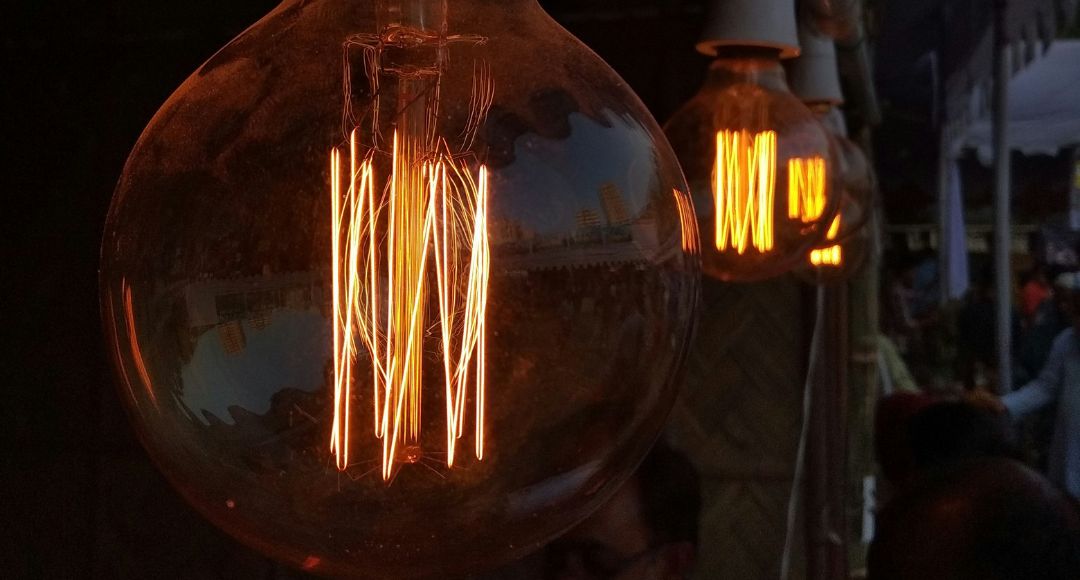
If you love the warm glow of a traditional incandescent but don’t want the cost that comes with it, LED filament bulbs are the perfect “fittings” for you!
LED filament bulbs are modern LEDs arranged to look like old-school filament lamps. They give that warm, vintage look people love in exposed fittings, cafes, and homes. But many buyers worry: What is the brightest LED filament bulb? Are filament bulbs bright enough for main lighting?
The short answer? Yes… but only if you choose the right one. Here’s the thing: brightness is measured in lumens, not the filament’s appearance.
In this post, we’ll guide you in determining exactly which filament lamp will light your room properly. We’ll discuss important factors like lumen and tone. And most importantly, we’ll break down in detail our recommended bright filament bulbs:
- 7.2W B22 GLS LED Bulb – Cool White 6500K
- E27 Smart LED Dimmable and CCT Changing Filament Bulb
- ST64 LED Filament Lamp, E27 Screw, Amber 2200K Dimmable
Understanding brightness in LED filament bulbs
Lumens: The Real Measure of Brightness
This might come as a shocker to many, but watts does not determine how bright a light is… at least not with the modern LED bulbs, which include LED filament bulbs.
Lumens (lm) measure the total light a bulb produces. More lumens = more light, which means that if you’re looking for a brighter LED bulb, you need to look for a higher lumen count.
Here are common ranges for filament-style lamps:
- 250-470 lm — decorative or accent (soft glow, mood lighting)
- 470-806 lm — standard room brightness (typical main light for smaller rooms or supplementary lighting)
- 1000+ lm — high-brightness filament models suitable as a main light in many rooms
Important note: Filament bulbs can be just as bright as standard LED bulbs; it depends entirely on the lumen rating.
Colour Temperature: Why They Often Seem Dim
Most filament bulbs are sold in warm white (about 2200K-2700K). This is why they often seem dimmer than standard LED bulbs. Warm light looks softer and more yellow than cool white, so even at the same lumens, a warm filament lamp can feel less intense.
If you want a perception of extra brightness, choose a higher colour temperature (cooler white), but note that it can change, or even entirely eliminate the vintage vibe many of us choose filament bulbs for.
Glass Type and Light Spread
There are two more things that change how bright a filament bulb seems in a room:
Glass type
- Clear glass shows bright filaments and lets more direct light through.
- Frosted glass softens and scatters the beam, reducing perceived glare and the sense of raw brightness.
Beam angle and distribution
Many filament bulbs are designed to provide a near 360-degree distribution, spreading luminous flux throughout the room. A wide spread helps with ambient lighting, but it reduces intensity in any single direction compared with a focused spotlight.
Lampshades, diffusers and fittings also change how much useful light reaches your surfaces. A pendant with a tight shade will reduce the effective brightness regardless of lumens.
The Brightest Types of LED Filament Bulbs (Our Featured Picks)
7.2W B22 GLS LED Bulb – Cool White 6500K
This is for those looking for serious brightness from a filament-style bulb. This bulb goes far beyond a soft decorative glow, delivering an impressive 1,521 lumens while using only 7.2 watts. That’s roughly equivalent to a traditional 100W incandescent bulb, but far more energy efficient.
With its 6,500K cool white colour temperature and wide 320 degree beam angle, it produces crisp, daylight-style illumination that works brilliantly in large living rooms, open-plan kitchens, garages or workshops.
Expert tip: If you are using this as your main ceiling light, keep the fitting open or lightly shaded to make the most of its high lumen output.
E27 Smart LED Dimmable and CCT Changing Filament Bulb
Great for homes that need flexibility, this smart filament bulb offers 700 lumens from just 6.5 watts, making it similar in brightness to a traditional 60W incandescent. What makes this one stand out is its adjustable colour temperature. You can switch from a cosy, warm white to a clearer, cooler tone depending on the time of day or task.
This LED filament bulb is ideal for living rooms, bedrooms, or dining spaces where you want both ambience and usable brightness.
Expert tip: Set it to a cooler white tone when reading or working, and switch to a warmer tone in the evening for a softer, more relaxed feel.
ST64 LED Filament Lamp, E27 Screw, Amber 2200K Dimmable
If your priority is decorative warmth with moderate brightness, this filament bulb produces 470 lumens at just 5 watts, roughly comparable to a 40W incandescent bulb.
With its rich 2,200K amber glow and full 360-degree beam angle, it’s designed to draw attention. This makes it perfect for exposed pendants, bedside lamps, or statement fittings over dining tables where mood matters more than high-output lighting.
Expert tip: Use multiple fittings to increase overall brightness, as this lumen level is best suited for ambient lighting rather than powering a whole room on its own.
Filament Bulb vs Standard LED: Brightness Comparison
Here’s the simple truth of lighting: if you match lumens, you match brightness.
An 806-lumen filament bulb produces the same amount of light as an 806-lumen standard LED bulb. The lumen rating does not change just because the inside looks vintage. Lumens are lumens.
So if brightness is equal, what actually changes? The decision becomes about atmosphere or how the light feels.
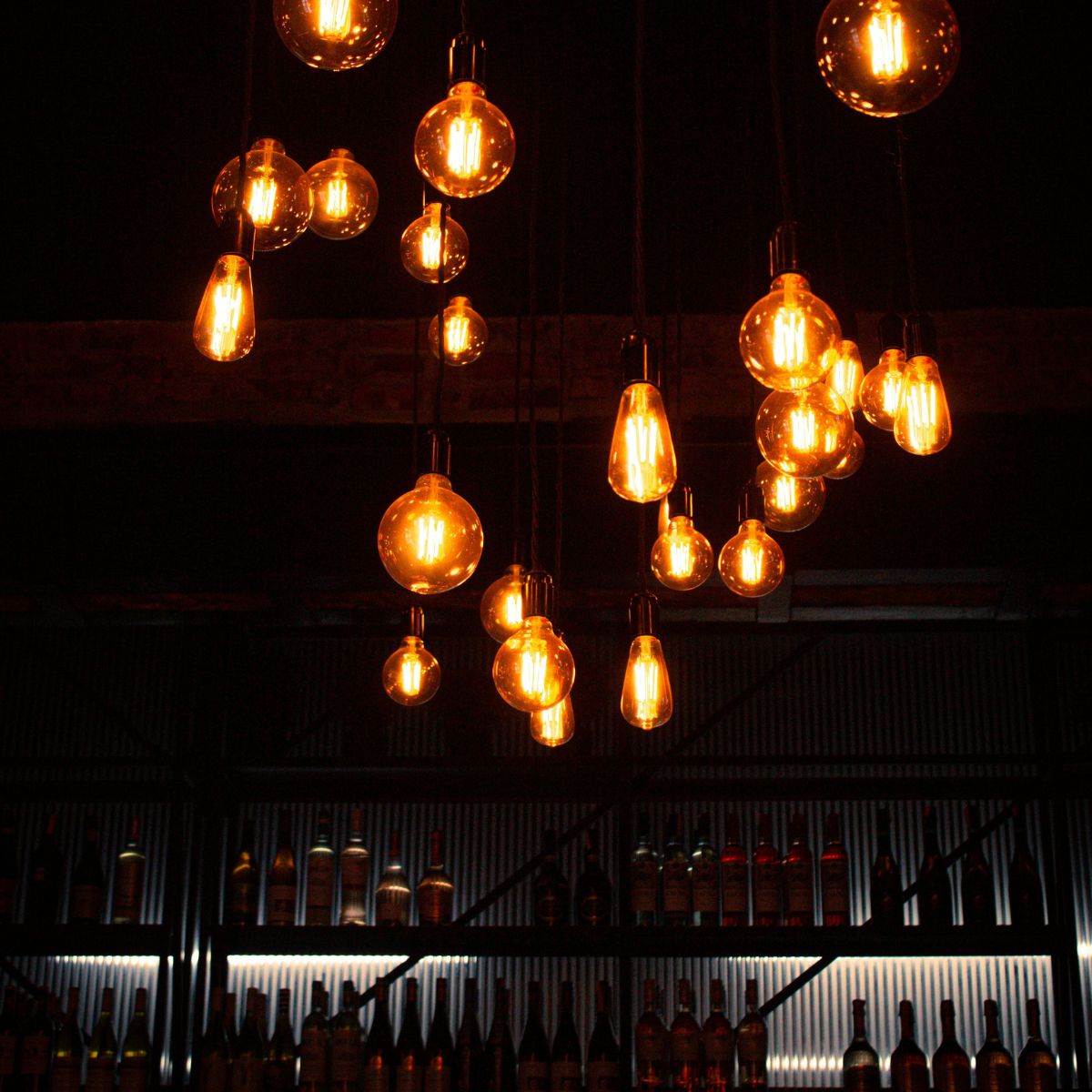
With the same 806-lumen filament example, especially if it’s in warm white (2,700K or lower), light spreads in a wide, often near-360-degree pattern. The glow feels softer and more ambient because the light radiates outward in all directions.
This makes filament bulbs excellent for open pendants, living rooms, dining areas and spaces where visual comfort matters.
An 806 lumen standard LED bulb, on the other hand, is often more directional. Even if it has a wide beam angle, the design usually sends more light downward or forward. If it is natural white (4,000K) or higher, it will also appear sharper and more intense.
That combination makes standard LEDs better for task lighting, kitchens, desks and utility areas where you need focused visibility.
Let’s look at this comparison side-by-side:
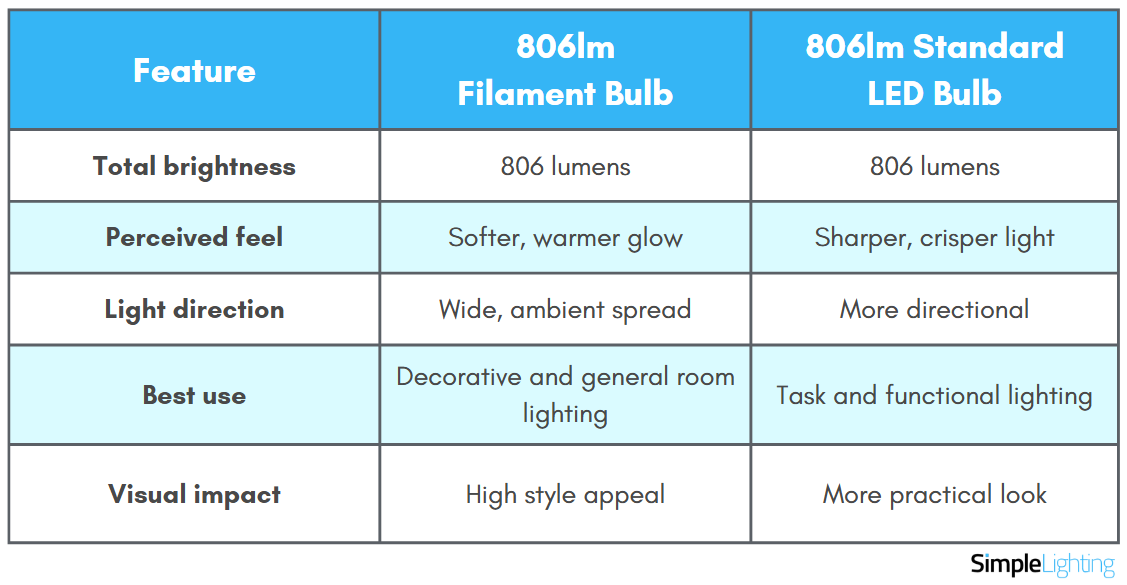
If you want character, warmth, and a classic visible filament design, choose an LED filament bulb.
If you want precision, clarity, and stronger task lighting, choose a standard LED bulb.
Remember: Brightness is decided by lumens. The rest is about how you want the room to feel and function.
Where You Can Use Bright LED Filament Bulbs
So, where does it make sense to use LED Filament Bulbs?
Living rooms
Great for open-plan living if you choose higher lumen filament bulbs. Mix multiple fittings for even coverage and include adjustable fixtures for tasks.
Bedrooms
Filament bulbs are ideal for warm, relaxing atmospheres. Use lower lumen filament bulbs for bedside lamps. For main ceiling lights, choose 700-1,000 lm models if you prefer a filament-style look.
Dining areas
Exposed filament bulbs over a dining table will look excellent. If you want the table very well lit, choose bulbs with around 700-1,000 lumens and pair them with dimming functions.
Hallways
Hallways benefit from wide distribution lighting. A 700+ lumen filament will keep corridors well-lit without harshness.
Open pendant fixtures
Filament bulbs show their best in pendants. If a pendant is the primary room light, fit it with a high-lumen filament bulb or use several pendants to reach the desired total lumens.
Common Mistakes When Choosing LED Filament Bulbs
LED filament bulbs are great, as long as you avoid these common oversights:
1. Choosing a 250-lumen filament for a main ceiling light. That lumen level is decorative only. You want a fitting with a higher lumen rating, like our first recommended filament bulb, which has 1521 lumens.
2. Assuming all filament bulbs are dim. Many are bright if they have high lumens; check the lumens label.
3. Not checking the lumen rating. Packaging sometimes highlights watts rather than lumens. That can be misleading. Always compare lumens when choosing your lights.
4. Choosing very warm (2200K) bulbs for kitchens. Kitchens need clearer light; 3,000K-4,000K or adjustable CCT is better.
5. Ignoring fitting type. Make sure you order the correct base (E27, B22, E14, etc.) and check if the fitting is enclosed; that affects bulb choice.
Ready To Choose The Brightest LED Filament Bulb?
When looking for the brightest LED filament bulb, always remember:
- Lumens determine brightness. Always check lumens first.
- The standard room brightness is about 806 lumens.
- 1,000 lumens and above qualify as very bright for filament bulbs.
- Warm white filament bulbs look softer and often feel dimmer than cool white bulbs, even at the same lumen rating.
- Filament bulbs can absolutely serve as main lighting when you choose high-lumen models or use multiple fittings.
- Filament bulbs are not always the best choice. For task-focused spaces, consider directional standard LEDs if you need intense, focused light.
If you want decorative vintage looks with real practical light, choose a filament bulb by lumen and Kelvin (colour temperature), not by filament style alone. That way, you get the atmosphere and the function in one glowing glass bulb.
Browse through Simple Lighting’s wide range of LED filament bulbs and find the perfect bright fitting for your space.
Frequently Asked Questions
Are LED filament bulbs bright enough?
Yes, LED filament bulbs are bright enough if you choose the right lumen rating. Models around 700 to 806 lumens work for standard room lighting, while 1,000 lumens or more provide very bright illumination. The key is to check lumens, not just the filament style.
What is the brightest LED filament bulb available?
High-output filament bulbs can exceed 1,000 lumens, with some models like our recommended bulb reaching 1,500 lumens or more. These are comparable to traditional 100W incandescent bulbs and are suitable for main room lighting. Always check the product’s lumen specification to confirm.
How many lumens do I need for a filament bulb?
For decorative lighting, 250 to 470 lumens is usually enough. For general room lighting, aim for around 806 lumens per main fitting. Larger rooms or brighter spaces may require 1,000 lumens or multiple bulbs.
Do filament bulbs give off enough light for a room?
Yes, they can provide enough light for a room if you select a high-lumen version or use multiple fittings. Lower-lumen filament bulbs are better suited to ambient or feature lighting. Matching the lumen output to the room size is essential.
Are filament bulbs brighter than standard LEDs?
Filament bulbs are not inherently brighter than standard LEDs. Brightness depends on lumens, and both types can produce the same light output at the same lumen level. The main difference is appearance (temperature + glass type) and light distribution (beam angle).