
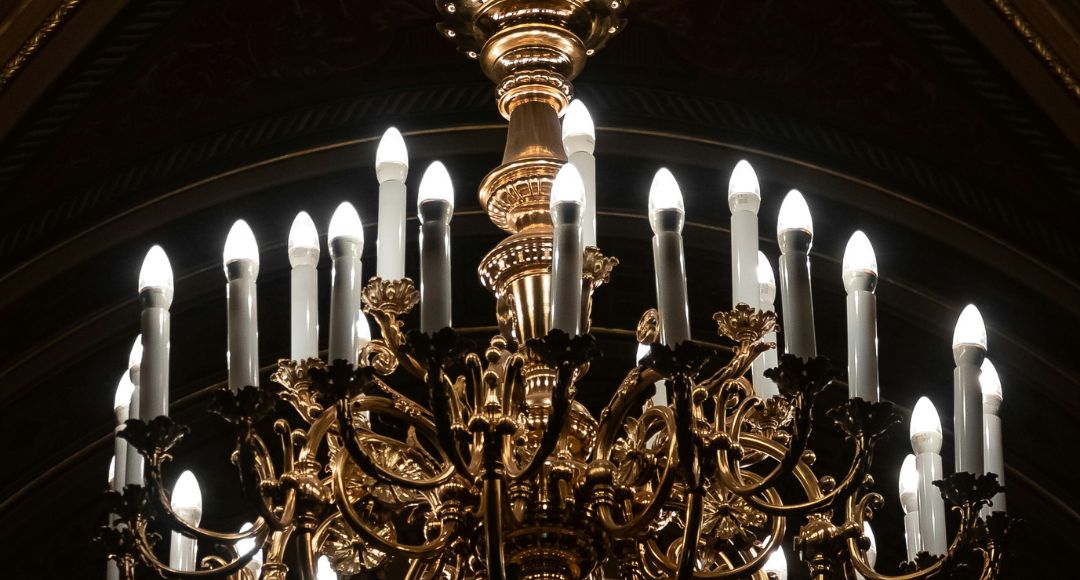
When it comes to compact light fittings, the E14 LED bulb is a small but mighty performer. Commonly used in table lamps, wall lights, chandeliers, decorative fittings, and accent luminaires, this screw-base bulb fits neatly where your standard E27 bulbs simply cannot.
But not all E14 LED bulbs are made the same. Depending on your needs, you’ll want a brighter or a dimmer E14 bulb. This begs the question: What is the brightest E14 LED bulb available?
And, no, the answer isn’t about wattage. In modern LED lighting, lumens determine brightness, not watts. A lower-wattage LED can easily match, and sometimes even outperform, its halogen counterpart in brightness.
That’s why understanding how brightness works will help you choose the right E14 bulb for different uses in kitchens, bedrooms, living spaces, or commercial environments.
In this guide, we’ll review our top E14 LED bulb picks:
- Energizer, 4 x LED Candle Bulbs, E14, 4.9w – Warm White 3000K
- E14, 2.2w LED Candle Bulb, A Rated Filament Style – 6500K Cool White Energizer
- 4.5w Smart LED Candle Bulb
We’ll also break down:
- What actually makes an E14 LED bulb bright
- How colour temperature and beam angle affect perceived brightness
- Where to use high-output E14 bulbs in your home
Let’s start with the fundamentals.
Understanding Brightness in E14 LED Bulbs
When choosing an E14 LED light bulb, you don’t just pick the one with the highest wattage and then move on. There are several factors that affect what’s called brightness perception.
Lumens (Brightness Output)
Lumens is the measurement of the total amount of visible light emitted by a bulb. Simply put, the higher the lumen rating, the brighter the bulb.
But sadly, many people still confuse watts with brightness. That’s old thinking. Watts measure energy consumption, not light output.
In traditional halogen or incandescent bulbs, higher wattage usually meant brighter light because those technologies were inefficient. Most of the energy was still transformed into heat instead of light, so you needed more wattage to compensate.
LEDs changed the game by converting most of the energy the bulb gets into light, with minimal waste. For example, a 35W halogen candle bulb produces around 400 lumens, while an LED candle bulb can produce similar or even higher lumens at just 4-5W.
Typical lumen ranges for an E14 LED bulb are as follows:
- Low Intensity (Ambient/Decorative): 150-300 lumens
- Medium Intensity (General Use): 400-500 lumens
- High Intensity (Task Lighting): 600-900+ lumens
Colour Temperature
But despite everything we said about lumens, it isn’t everything when it comes to brightness.
The colour temperature or tone of the light, measured in Kelvin (K), also affects how bright a space feels… even if the lumens are identical.
Now that’s the interesting part:
Two bulbs can have the same lumens, but have different colour temperatures, and the cooler one often appears brighter.
Why? Because cool white light has more blue tones, which our eyes perceive as sharper and more intense. Surfaces appear crisper, colours look more defined, and shadows become clearer.
Warm white light, by comparison, softens edges and reduces contrast. It feels softer and more relaxed, even at the same lumen level.
The different colour temperatures are as follows:
- 2700K – Warm White: soft, cosy, yellow-toned
- 4000K – Natural White: clean and balanced
- 6000K – Cool White: crisp, bright, daylight-like
If your E14 bulb feels “dim”, it might not be due to low lumens. It might simply have a warmer light.
Quick tip: If you’re looking for bright lighting, opt for cooler lights.
Beam Angle
Beam angle determines how wide the light spreads.
Imagine pouring water from a jug: a narrow stream hits one spot intensely, while a wide splash spreads across the table. Light works in a similar way.
- A narrow beam means that the light is more focused, sharper, and effectively brighter since there’s more concentrated illumination.
- A wide beam spreads light across a larger area, dispersing the illumination.
Most E14 LED bulbs have beam angles between 180° and 360°.
- In chandeliers and decorative fittings, a wide beam works best because it evenly fills the room.
- In reading lamps or wall-mounted fixtures, a slightly narrower beam can feel brighter because the light is concentrated.
So, always check the beam angle if you want the maximum perceived brightness for your setup.
Top Picks for the Brightest E14 LED Bulbs
Now let’s look at practical examples. These recommendations reflect common high-performance E14 options available at Simple Lighting.
Energizer 4-Pack LED Candle Bulbs with 3 Years Warranty
This pack of four E14 LED candle bulbs is an energy-efficient choice, with a power consumption of only 4.9W. It produces 470 lumens of brightness at a 200-degree beam angle. This light provides warm white light at 3,000K, creating a welcoming atmosphere that’s perfect for living rooms and bedrooms.
These bulbs are the perfect replacement for 40W traditional incandescents, ensuring significant yearly energy savings. Take note that the warmer colour temperature slightly reduces perceived intensity. This makes it ideal for spaces where comfort is more important than sharp task visibility, such as living rooms and bedrooms.
Best for: General lighting with a cosy ambience.
Energizer 2.2w A-Rated Filament Style LED Candle Bulb
This is a good example of why you need to check lumens, not watts, when looking for a brighter LED light bulb.
The light bulb uses only 2.2W to produce the same 470 lumens of brightness. This also has a wider beam angle of 320 degrees and a 6500K colour temperature. But despite having the same lumens, most will perceive this bulb as brighter compared to the one above because of its cooler tone. The light is softer too, since the light beam is wider.
This bulb is the most efficient performer in the group. Despite matching lumens with the 4.9W E14 bulb above, the cooler 6500K colour temperature makes it appear noticeably brighter to the human eye. The wider beam angle also reduces shadowing, creating a more evenly lit space.
In practical terms, this bulb will feel the brightest in kitchens, hallways, and work areas, even though the lumen rating is identical to the first product.
Best For: Task lighting and areas where clarity and brightness are priorities.
4.5w Smart LED Candle Bulb with 2 Years Warranty
This E14 bulb’s power consumption is between the other two above, at 4.5W. The bulb produces 380 lumens of maximum illumination. It has a narrower beam angle of 180 degrees, and colour can be adjusted between RGB, white, and warm white. You’re also able to access 8 scene modes, perfect for setting the right ambience for your space.
This bulb is designed more for controlled ambience than maximum illumination. The narrower beam angle and lower lumen output make this light ideal for accent lighting.
When set to cooler white, it can appear sharper. When set to warm white or RGB colours, you can set the mood at the expense of brightness perception. And, as with most smart bulbs, this is dimmable, allowing the overall output to be adjusted to suit the environment. Useful in multi-use spaces such as living rooms.
Comparative Brightness Analysis
Brightness is never just a number. It is how the light fills a space, how it feels on surfaces, and how it supports the room’s function.
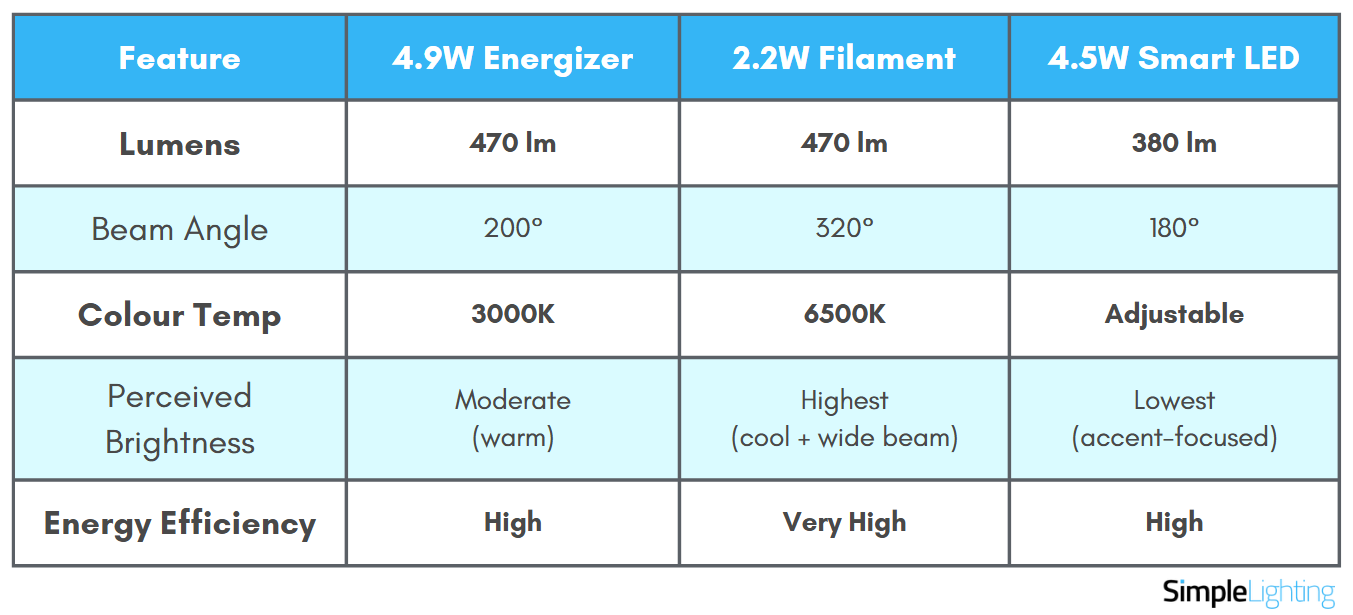
If your goal is maximum brightness with minimal energy use, the 2.2W A-rated filament bulb delivers the strongest overall performance.
If you want comfortable, ambient general lighting, the 4.9W warm white option offers balanced output.
If you prioritise flexibility and mood control, the smart bulb trades raw brightness for atmosphere and adjustability.
Here’s a side-by-side comparison of the featured bulbs:
Where to Use Bright E14 LED Bulbs
Choosing the brightest E14 LED bulb depends on the room and its purpose. It’s not just about chasing the highest lumen number. Light behaves differently depending on where you use it. In some rooms, you want clarity and focus. In others, you want atmosphere.
Because E14 bulbs are often used in multi-arm fittings, total brightness is usually the combined output of several bulbs working together.
For example:
- 3 x 380 lumens = 1,140 lumens
- 5 x 470 lumens = 2,350 lumens
- 6 x 470 lumens = 2,820 lumens
That quickly becomes strong, effective room lighting.
Here’s how to choose correctly depending on the room and the atmosphere you want to create.
Here is how to get that balance right.
Living Rooms
Living rooms are multi-purpose spaces. One evening it is a cinema. Next, it is a reading corner, a game room, or a place to host guests.
- Use 380 lumens bulbs in decorative lamps and for mood lighting as they give a softer and cosier glow.
- Use 470 lm bulbs where you need more practical light, for example, in a reading corner, next to a sofa, or in a ceiling fixture if the room is darker.
For chandeliers or multi-arm fittings: mix and match.
- A chandelier with 5 x 380 lumen bulbs gives 1900 lumens total.
- With 5 x 470 lumen bulbs, you’ll get 2350 lumens.
Both of these are workable depending on how bright you want the space to be.
Tip: Combine general (ceiling) light with table lamps, so you can switch between bright and relaxed settings when needed.
Bedrooms
Bedrooms are rarely about maximum brightness. They are about comfort, calm, and control.
You usually do not need maximum output unless the light fitting is the only source of illumination.
Best choice:
- 380 bedside lamps and ambient wall lights; it’s warm and not too harsh for winding down.
- 470 lumens in the reading lamp or a directed lamp head so light is concentrated on the book without lighting the whole room.
Warm white is typically the better option here. Even at 470 lumens, warm light will feel softer and more relaxing than cool white at the same brightness.
Tip: If you want both bright and cosy, put a 470 lm bulb in a task lamp and 380 lm bulbs in the rest of the room.
Kitchens and task areas
This is where brightness truly matters. Kitchens benefit from brighter, clearer light. Use 470-lumen bulbs in fittings above worktops, in cooker hoods if suitable, or in pendants above an island. Natural or cool white light is generally preferred.
If the fitting has multiple bulbs, the total output will be more than enough for general lighting. For example: 4 x 470 lumens = 1,880 lumens
That provides strong overall illumination in a small to medium kitchen.
Tip: Cooler colour temperatures make kitchens feel cleaner and brighter. Warm white may look softer, but it can reduce visual sharpness.
Accent Lamps and Decorative Fittings
In accent lighting, brightness is about balance. Table lamps, wall sconces, and feature lights typically work best with:
- 380 lumens for soft background lighting
- 470 lumens if the lamp is used for reading
If the goal is atmosphere, warm white at 380 lumens creates a gentle glow. If the goal is functionality, 470 lumens in natural white give clearer visibility.
Final Thoughts
So, what is the brightest E14 LED bulb?
It’s not just the one with the highest wattage. It is the one with the right lumen output, suitable colour temperature, and correct beam angle for your space.
The general rule is: Always check lumens first.
But lumens are also not everything. Further refine your choices with colour temperature and beam angle.
The key is understanding how these three work together in each space. Once you match brightness to purpose, your E14 LED bulbs will do exactly what they are meant to do: enhance your space.
Check out our recommended E14 LED bulbs from Simple Lighting today.
Frequently Asked Questions
How bright can E14 LED bulbs get?
Most high-output E14 LED bulbs reach around ~450 to ~800 lumens, which is equivalent to traditional 40W to 60W incandescent candle bulbs.
Why do some E14 LEDs look brighter even at the same lumens?
Colour temperature plays a major role. Cool white (6500K) appears brighter than warm white (3000K) even at identical lumen levels.
Do brighter E14 LED bulbs use more electricity?
Not necessarily. Brightness is measured in lumens, while energy consumption is measured in watts.
Can I replace a halogen E14 with an LED for better brightness?
Yes! LED E14 bulbs typically provide equal or greater brightness while using significantly less energy. They also last much longer and are an overall cost-effective lighting solution than traditional lights.
Which colour temperature looks brightest for living spaces?
Cool white looks brightest, but for comfort in living rooms and bedrooms, warm white is often preferred. Natural white offers a balance between clarity and comfort.
Does beam angle affect how bright a bulb feels?
Yes. A narrow beam concentrates light into a smaller area, making it appear more intense. A wide beam spreads light evenly across the room. Most E14 candle bulbs have wide beam angles designed for ambient lighting in chandeliers and wall fittings.